Caribbean
Three low limestone islands in the western Caribbean where you can shore-dive off the capital in the morning and drink a local lager on Seven Mile Beach by afternoon.
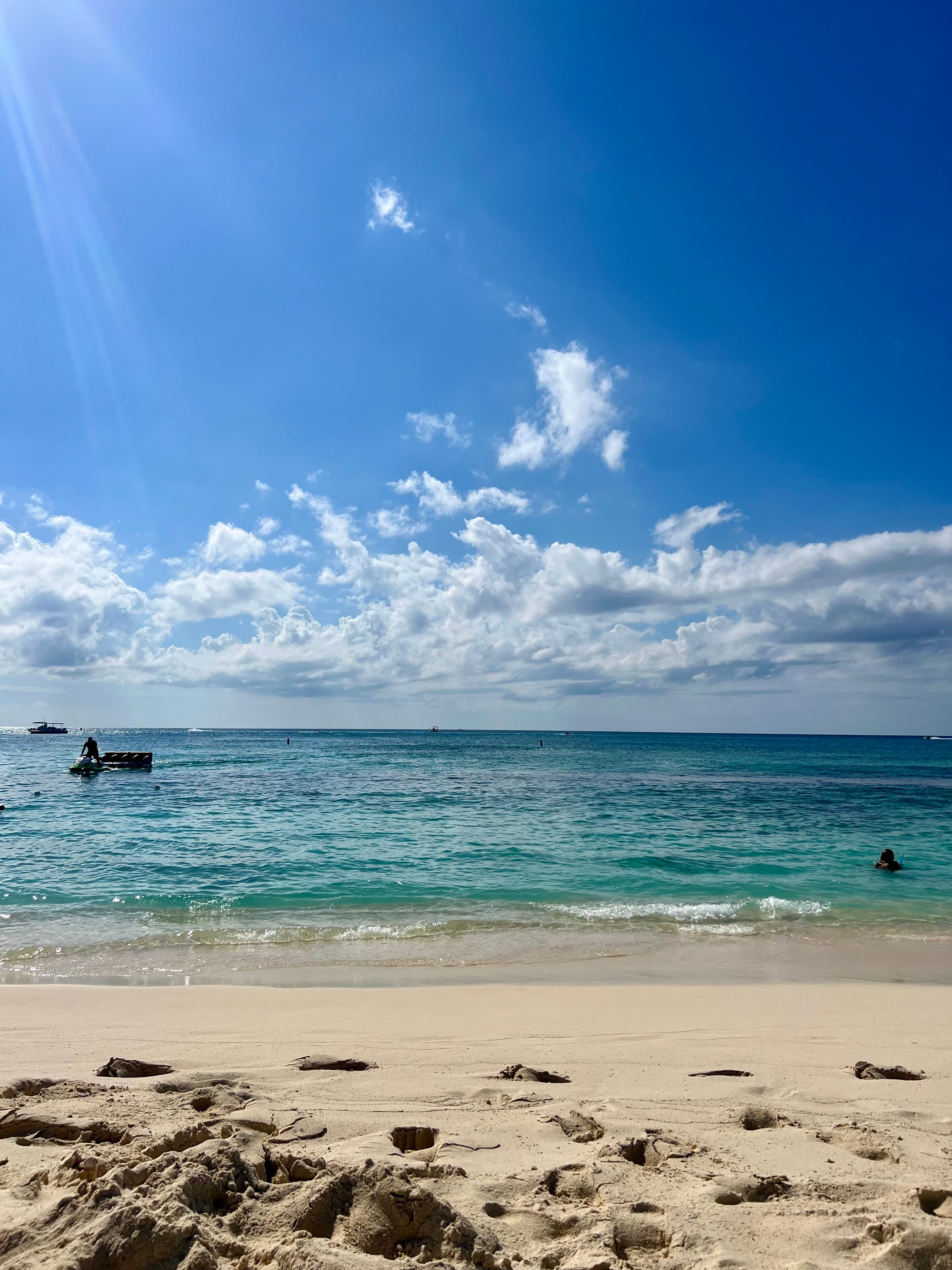
Grand Cayman, captured on my trip.
Things to Do
Start in George Town, where two of the best shore dives in the Caribbean, Eden Rock and Devil's Grotto, sit a short swim off South Church Street: a honeycomb of coral caverns and tunnels lit by shafts of sunlight and packed with silversides and tarpon in summer. From there the island opens up. Float over the famous sandbar at Stingray City in the North Sound, where southern stingrays gather in waist-deep water. Drive out to West Bay for the Cayman Turtle Centre and the blackened limestone formations locals simply call Hell. Spend an afternoon on Seven Mile Beach with a cold Caybrew, then cross to the quieter north shore for Rum Point and Starfish Point. Certified divers should book a boat out to the wall dives that ring the island and the wreck of the USS Kittiwake, a decommissioned US Navy ship sunk off Seven Mile Beach in 2011 as an artificial reef.
Recommended Experience
Stingray City Sandbar Tour
A boat trip out to the sandbar in the North Sound, where southern stingrays gather in shallow, waist-deep water. It is the calmest and most reliable way to see them up close, and an easy half-day even on a cruise stop.
Recommended Experience
Two-Tank Boat Dive on the Cayman Wall
A guided two-tank dive out to the drop-offs that ring Grand Cayman, where the reef runs out and then falls away into open blue. For certified divers; the shore dives at Eden Rock and Devil's Grotto in George Town are the easier option if you would rather stay close in.
The Building That Holds More Companies Than the Country Has People
Fewer than 90,000 people live in the Cayman Islands. More than 100,000 companies are registered there. The territory has no income tax, no corporate tax, and no capital gains tax, which is why so much of the world's money is legally domiciled on an island most people picture only as a beach. The most famous address in George Town is Ugland House, a five-story building on South Church Street that serves as the registered office for around 19,000 companies, a figure that has run into the tens of thousands over the years. Barack Obama once said the place had to be either the world's largest building or its largest tax scam. It is neither: a US government investigation found no illegal activity, and the vast majority of those companies are legal entities, hedge funds, and multinational subsidiaries that keep their paperwork, not their staff, on the island.
Named for Turtles, Then Renamed for Crocodiles
When Christopher Columbus was blown off course on his fourth and final voyage in May 1503, the first land he saw here was so thick with sea turtles that he named the islands Las Tortugas. What most people miss is that the islands he actually sighted were the two smaller Sister Islands, Cayman Brac and Little Cayman, not Grand Cayman. The name did not last. A 1523 map labelled them Los Lagartos, meaning lizards or alligators, and by 1530 they were being called Caymanas, from a Carib word for the marine crocodiles that once lived here. The turtles Columbus saw were hunted so heavily by passing ships restocking on meat that they were nearly wiped out of local waters. Today the green sea turtle is a national symbol, and when Jamaica became independent in 1962, the Cayman Islands chose to stay a British territory, which they remain.
The Reef That Falls Into the Deepest Point in the Caribbean
The Cayman Islands are the exposed peaks of the Cayman Ridge, an undersea mountain range, and just to the south of them the seabed collapses into the Cayman Trench, which at 7,686 metres, or 25,217 feet, is the deepest point in the entire Caribbean Sea. That geology is the whole reason the diving here is world-class. Instead of a gentle slope, the reef around the island runs out for a few hundred metres and then drops off a vertical wall into open blue, some of it plunging thousands of feet. Grand Cayman has hundreds of named dive sites, and the leeward west coast off George Town is diveable almost year-round. It is here, off the capital's waterfront, that the shore dives at Eden Rock and Devil's Grotto let you swim through coral caverns without ever getting on a boat.
The Beach That Was Never Quite Seven Miles
Seven Mile Beach is the island's headline attraction and one of the most consistently ranked beaches in the Caribbean, a long crescent of soft white coral sand running north from George Town along the west coast. The name, though, is aspirational. A generous measurement puts it a little over six miles, and after decades of storms and erosion many locals will tell you it is closer to five and a half. It is also entirely public by law: every foot of beach in the Cayman Islands is open to everyone, no matter which resort sits behind it. The move at the end of the day is simple. Find a spot on the sand, order a Caybrew from the nearest beach bar, and watch the sun go down over the water.
Best Time to Visit
The dry season from December to April is the sweet spot: warm days, calm and clear water, and the best diving visibility of the year. It is also peak season, so flights and hotels run at their highest, and the stretch around Christmas and New Year books out early. Late spring and early summer bring warm water and thinner crowds. Hurricane season runs June to November, with the highest risk in September and October; Grand Cayman was hit hard by Hurricane Ivan in 2004, and while direct hits are rare, it is worth watching the forecast if you travel then.
What to Eat and Drink
The Cayman Islands Brewery, launched in 2007, is the only brewery on the island, and its flagship lager, Caybrew, is the beer you will see in every beach bar and cooler. It has taken international gold medals for quality, and the brewery leans hard on the islands' famously clean water, purifying it to 99.9 percent before brewing. Beyond the beer, look for conch, cracked or in fritters, fresh mahi-mahi and snapper, and heavy cake. And do not leave without a Tortuga rum cake, the island's best-known edible export, named for the same turtles that gave the Cayman Islands their first name.
Where to Stay
Most visitors base themselves on or near Seven Mile Beach, which puts the best swimming, dining, and sunsets on your doorstep with George Town a short drive south. Divers have a fourth option worth knowing about: Sunset House, a laid-back George Town dive hotel with a house reef and easy shore access, a Grand Cayman institution since 1958. Cayman is not a cheap island, so "budget" here is relative.
Budget: Sunshine Suites Resort, an all-suite hotel a short walk from Seven Mile Beach and the best value on the strip.
Mid-range: Grand Cayman Marriott Resort, reliable and right on the sand at the George Town end of Seven Mile Beach.
Luxury: The Ritz-Carlton, Grand Cayman, the island's flagship five-star resort on Seven Mile Beach, home to the Cayman Cookout food festival each January. The Kimpton Seafire Resort + Spa is the more contemporary alternative.
These are affiliate links — booking through them supports Viator Modus at no extra cost to you. Same room, same price, it just helps keep the guides coming.
These are affiliate links — booking through them supports Viator Modus at no extra cost to you. Same room, same price, it just helps keep the guides coming.
Getting Around
Renting a car is the easiest way to see Grand Cayman, and driving is on the left, a holdover from British rule. The island is small, so nothing is far: the airport, George Town, and Seven Mile Beach all sit within a few miles of each other on the west side. Public buses run frequently along Seven Mile Beach and out to the districts and are cheap, and taxis are plentiful but pricey, with fixed government rates rather than meters. If you are staying on the west coast and not planning to explore the East End or Rum Point much, you may not need a car at all.
Hidden Gems
On the north shore, Starfish Point is a shallow, calm spot where red cushion sea stars sit in the sand; look and photograph, but never lift them out of the water, since air kills them within minutes. The Mastic Trail cuts through one of the last untouched stretches of dry forest left in the Cayman Islands and sees a fraction of the beach traffic. And for a strange half-hour, the limestone formations at Hell in West Bay come with a tiny post office, so you can genuinely mail a postcard from Hell.
Is the Cayman Islands expensive?
Yes. It is one of the pricier destinations in the Caribbean, with resort rooms, dining, and drinks all costing more than on most neighboring islands. The upside is no sales tax on the price you see, and world-class diving that is often cheaper than the hotels around it.
Do you need a car in Grand Cayman?
Not necessarily. If you are staying on Seven Mile Beach, buses and taxis cover most of what you will want to do. A rental car is worth it if you plan to explore the East End, Rum Point, or the north shore.
What is the Cayman Islands known for?
Scuba diving, Seven Mile Beach, Stingray City, and its status as one of the world's largest offshore financial centers, with more registered companies than residents.
When is the best time to dive in Grand Cayman?
The dry season from December to April brings the calmest seas and the best visibility, though the leeward west coast off George Town is diveable almost all year.
Is Seven Mile Beach really seven miles long?
No. A generous measurement puts it a little over six miles, and erosion has trimmed it closer to five and a half in places. It is still the longest and most developed beach on the island.
Found this useful?
If this guide helped plan your trip to Cayman Islands, you can help fund the next one.
Buy me a coffee →