Caucasus
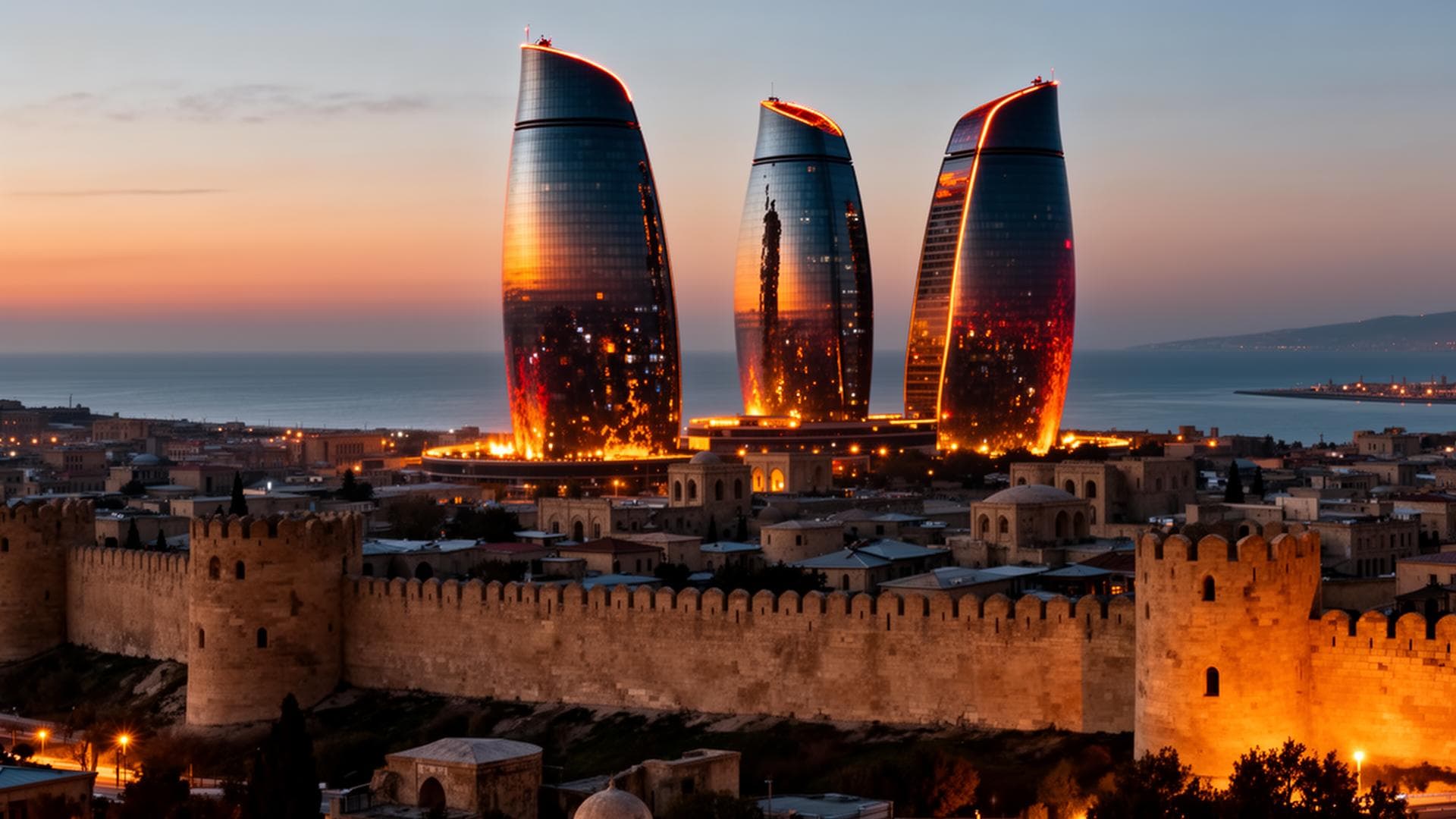
Baku is one of the most unexpected skylines on the Caspian Sea, a city where a UNESCO-listed walled old town sits in the shadow of the futuristic Flame Towers, and where Soviet-era boulevards run into oil-money glass. The capital of Azerbaijan has always been a crossroads: Persian, Russian, Ottoman, and Silk Road influences all left their mark, and the modern petro-boom layered something entirely new on top. The result is a city that feels both ancient and impossibly new, with a coastal promenade you can walk for hours and a culinary scene that pulls from every direction.
A few days in Baku on the Caspian, captured on my trip.
Things to Do
Get lost in Icherisheher, the walled Old City, and find the Maiden Tower and the Palace of the Shirvanshahs, both UNESCO World Heritage. Walk the full length of the Baku Boulevard along the Caspian, an eight-kilometer promenade that locals treat as a second living room. Visit the Heydar Aliyev Center for Zaha Hadid's flowing white masterpiece. Ride the funicular up to Highland Park for a panoramic view of the bay framed by the Flame Towers. Take a day trip to Gobustan National Park to see prehistoric rock carvings and the bizarre, bubbling mud volcanoes. Stop by the Yanar Dag "burning mountain."
The Land of Fire: Atashgah and Yanar Dag
About 30 km east of the city, in the Surakhani suburb, the Atashgah fire temple is a pentagonal complex built directly over a natural gas vent; the name means "home of fire" (atash, fire; gah, place). It's easy to file it away as a Zoroastrian temple, and the truth is more interesting. The surviving structure was built largely by Indian Hindu merchants working the Caspian trade routes in the 17th and 18th centuries, the earliest part dating to around 1713. Of its seventeen inscriptions, fourteen are Hindu, two Sikh, and one Persian, and the trident on the roof is a Hindu symbol. The site sits on far older fire worship, and scholars still debate an earlier Zoroastrian use, but what stands today is a place where Zoroastrian, Hindu, and Sikh fire-worship traditions converged on the same natural flame. That flame eventually went out as gas extraction dropped the underground pressure, sometime between the 1880s and 1969 depending on the source; what burns there now is fed by a pipeline, and the complex became a museum in 1975.
A little context makes the place legible. Zoroastrianism is one of the world's oldest religions, founded by the prophet Zarathustra (Zoroaster to the Greeks) in ancient Persia, modern Iran, somewhere between roughly 1500 BCE and the 6th century BCE; the dating is debated. Worship centers on Ahura Mazda, the "Wise Lord" and supreme creator, set against the destructive spirit Angra Mainyu, and it's often called one of the oldest monotheistic faiths, though scholars still argue whether it's strictly monotheistic or dualistic. The ethical core is plain: good thoughts, good words, good deeds. Fire (atar) is sacred as a symbol of Ahura Mazda, purity, and truth, but Zoroastrians don't worship fire itself, so the old "fire worshippers" shorthand misses the point. It was the dominant religion of pre-Islamic Persia until the Muslim conquest in the 7th century CE, and survives today mainly among the Parsis of India and small communities in Iran.
Half an hour north, on the Absheron Peninsula about 25 to 30 km from Baku, Yanar Dag is a natural gas fire that burns continuously along the base of a hillside, flames rising to around three metres out of porous sandstone. You'll read that it has burned for thousands of years; that isn't established. Local accounts say a shepherd set it off by accident in the 1950s, and while Absheron's natural fires have drawn travelers since Marco Polo passed through in the 13th century, this particular flame's age isn't proven. It's worth seeing, but be honest with your schedule: there's little there beyond the fire, so treat it as a quick stop, not an afternoon.
Best Time to Visit
April–June and September–October offer the best weather: warm, dry, and breezy off the Caspian. Summer can push past 35°C with high humidity, and the city's famous wind earns its name in winter. Bring a coat from November to March.
Where to Stay
Stay inside or right next to Icherisheher (the Old City) for atmosphere and walkability. The streets immediately around Fountains Square are also a strong choice, with easy access to restaurants, the metro, and the boulevard. Avoid basing yourself too far inland, the seafront is where Baku's charm lives.
Budget: Sahil Hostel & Hotel, clean, central budget option a short walk from Fountains Square and the metro.
Mid-range: Sapphire City Hotel, comfortable boutique stay tucked just outside the Old City walls with excellent breakfast.
Luxury: Four Seasons Hotel Baku, beaux-arts landmark on the Caspian boulevard with Flame Towers views and the city's best spa.
One practical note if you're catching an early or late flight: Fly Inn, the airport hotel, sits right next to the terminal and has an excellent sauna and spa, which makes a pre-dawn departure or a long layover a lot more bearable.
These are affiliate links — booking through them supports Viator Modus at no extra cost to you. Same room, same price, it just helps keep the guides coming.
Getting Around
The Baku Metro is clean, cheap, and the fastest way to cross the city. Use a BakiKart for tap-in access. Taxis via the Bolt app are inexpensive and easier than haggling. The old town and seafront are best done on foot. For Gobustan and Yanar Dag, hire a driver for the day. It's the most efficient way to combine the two.
Baku gave me probably the best first impression of any city I've visited. The road from the airport into downtown is lined with some of the country's most impressive buildings, and that's done intentionally. Drive a few minutes outside Baku and the glitzy architecture fades into more traditional Azeri life. I was hugely impressed with Azeri cuisine and hope to be back soon.
Hidden Gems
Most visitors never make it to the Carpet Museum, a rolled-carpet-shaped building on the boulevard with one of the most thoughtful textile collections in the region. Little Venice, a small canal park on the boulevard, is a charmingly kitsch leftover that locals still love. And the Soviet-era Funicular ticket booth at the bottom of Highland Park is a small piece of design history worth a closer look. For a low-key night, we ended up at Malacannes Shisha Lounge, smoking shisha drawn through a hollowed-out grapefruit.