East Asia
China's wartime capital is now one of the largest cities on Earth by population, a vertical megacity where monorails run straight through apartment towers. I visited in 2019, just before the world noticed.
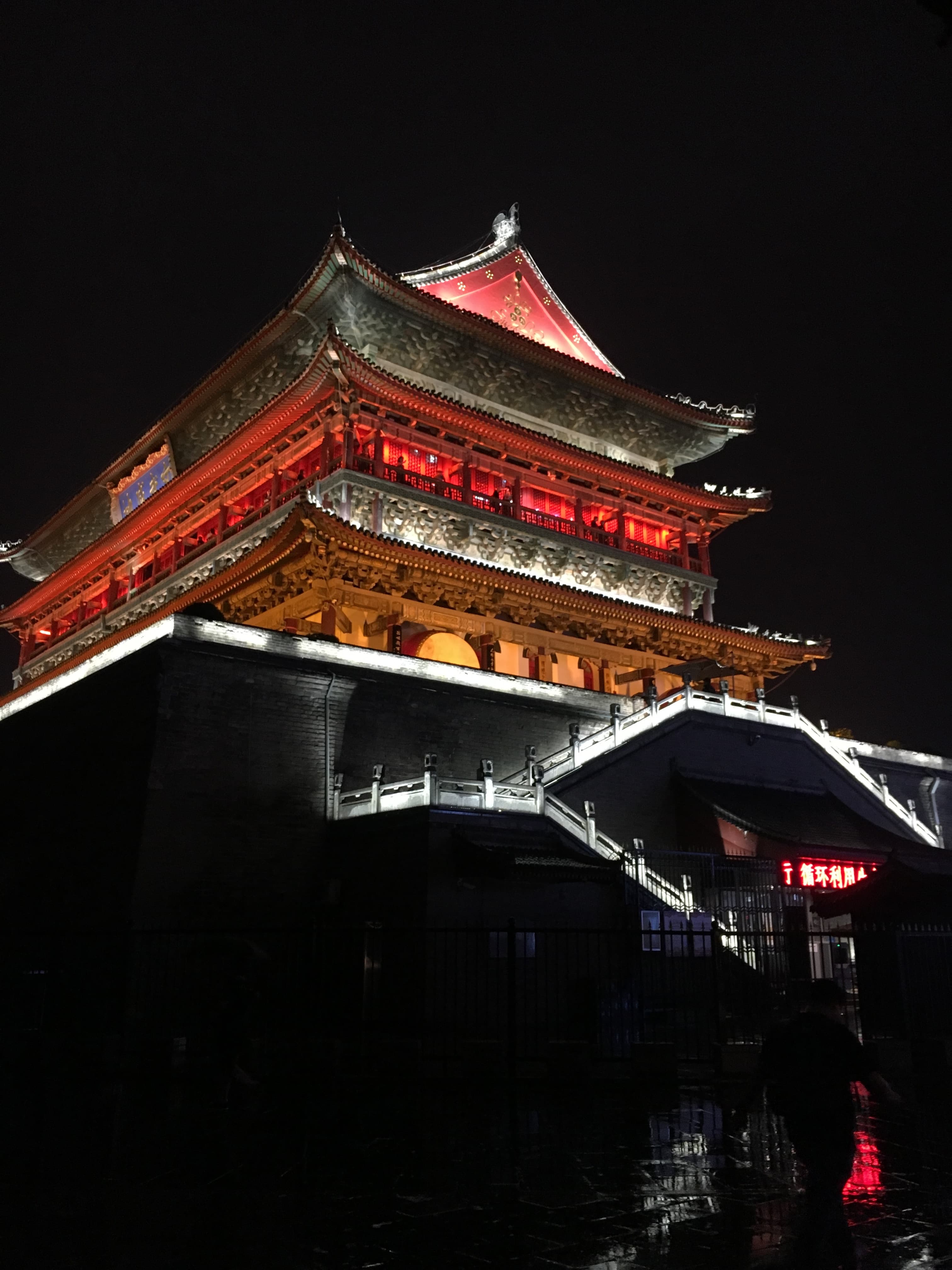
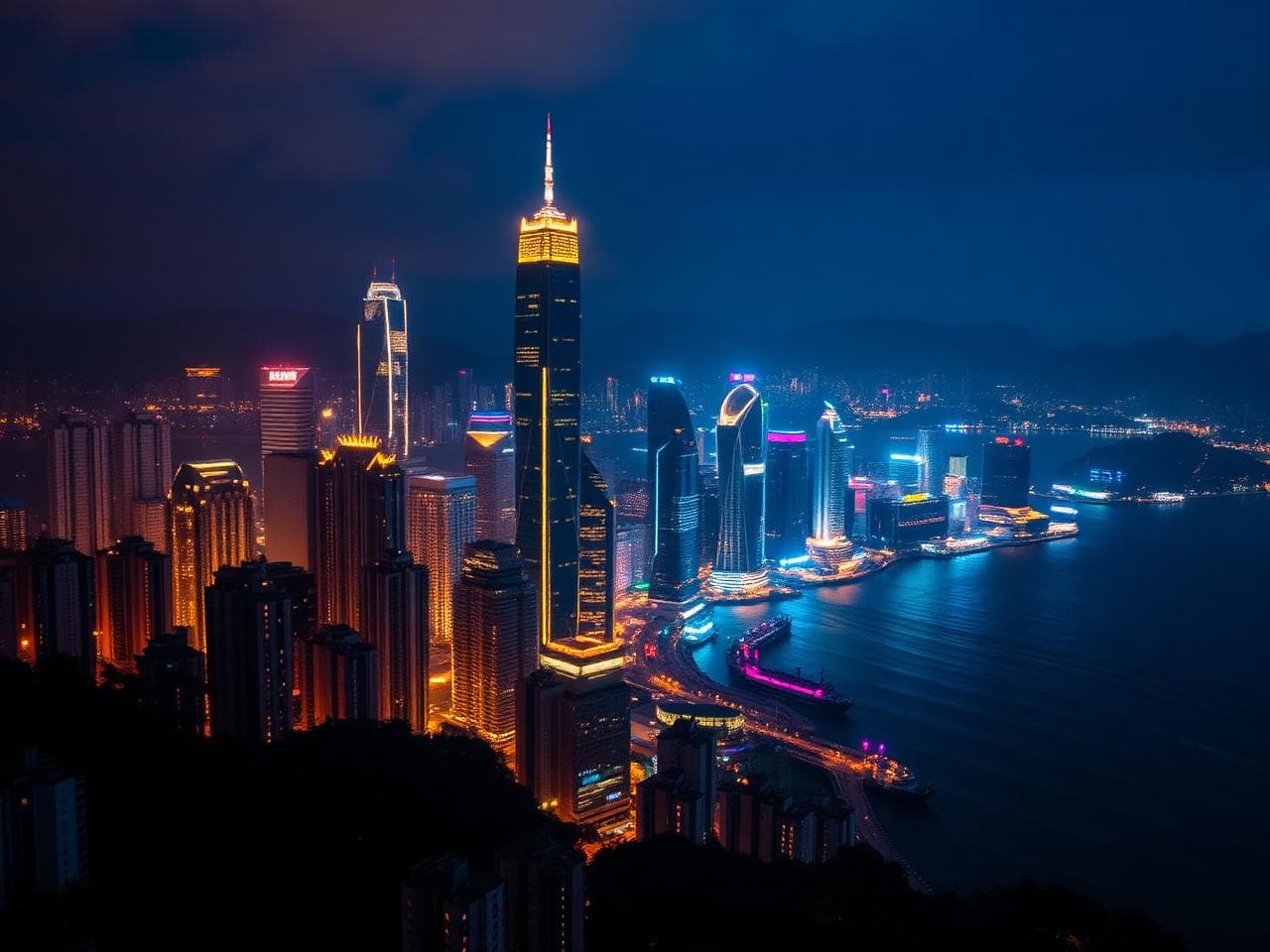
Chongqing, China's 8D vertical megacity, captured on my trip.
I visited Chongqing in September 2019, a year or two before the algorithm found it. Back then a foreign face was rare enough that people stopped to look. What I remember most was not a temple or a skyline. It was the sheer scale of the place, and the feeling that I was watching a city build itself in real time.
Most Westerners cannot place Chongqing on a map. That is strange for a city that governs more people than the entire population of Australia, and that ran China's government through most of the Second World War.
A city the size of Austria
In 1997 Chongqing was carved out of Sichuan province and made a direct-controlled municipality, one of only four in the country alongside Beijing, Shanghai, and Tianjin, and the only one deep in China's interior. Its borders spill across more than 80,000 square kilometers, roughly the area of Austria, most of it farmland and mountain.
That administrative sprawl produces one of travel's most misused statistics. By the official count, the municipality's 30-million-plus population makes it the largest city proper on Earth. It is also a bit of a trick: strip away the rural counties and the dense urban core holds closer to 8 or 9 million, with the wider urban area around 22 million. Either way, this is one of the most populous places most people have never heard of.
The reason it looks the way it looks is geography. Chongqing sits at the confluence of the Yangtze and the Jialing, wedged onto ridges too steep for a normal street grid. So the city went vertical instead. Roads stack over roads, rail lines thread through cliffs, and what reads as the ground floor on one street is the eighth floor on the next. Locals and the internet now call it the "8D magic city." Stand in it at night and the cyberpunk comparison stops feeling like a stretch.
The capital almost no one in the West remembers
When Japanese forces took Nanjing in late 1937 and then Wuhan in 1938, Chiang Kai-shek's Nationalist government retreated up the Yangtze and made Chongqing the provisional capital of the Republic of China. The mountains that make the city hard to build on also made it hard to invade. A city of under half a million swelled past a million as refugees poured in.
What followed is one of the least-known atrocities of the war. From 1938 to 1943 Japanese aircraft flew 268 raids on the city and dropped more than 11,500 bombs, most of them incendiary. It was among the earliest and longest sustained aerial bombing campaigns ever waged against a civilian population, beginning more than two years before the London Blitz. By the Chongqing government's own count, the raids killed close to 12,000 people and destroyed more than 17,000 buildings.
One detail sticks with me. The city's near-permanent river fog, the source of its other nickname, the "fog city," was an accidental shield. Japanese bombers could only aim on clear days, so the weather that makes Chongqing feel gray and closed-in is part of the reason it survived at all.
The people dug in, literally, carving air-raid tunnels into the hillsides. Many of those tunnels are still here. Some are now hotpot restaurants. That is a very Chongqing way to carry its history: not behind glass, but full of steam and chili oil.
Ciqikou: a thousand-year-old porcelain port
The old town I walked through, Ciqikou, is the last real fragment of the Chongqing that existed before the megacity swallowed everything. Founded around the year 998 under the Song dynasty, it grew wealthy in the Ming and Qing eras exporting porcelain down the Jialing. Its name literally means "Porcelain Port," and its dozen flagstone lanes still trace the shape of that trade.
At the center sits Baolun Temple, roughly 1,500 years old and therefore older than the town built around it. When the wartime capital arrived, painters, writers, and scholars sheltered in these streets. Today it is teahouses, Sichuan opera face-changing performances, and porter snacks eaten standing up. It is touristy now, and it was busy even in 2019, but it is the one place in the city where you can still feel old Chongqing under your feet.
Hongyadong: eleven stories of stilt houses on a cliff
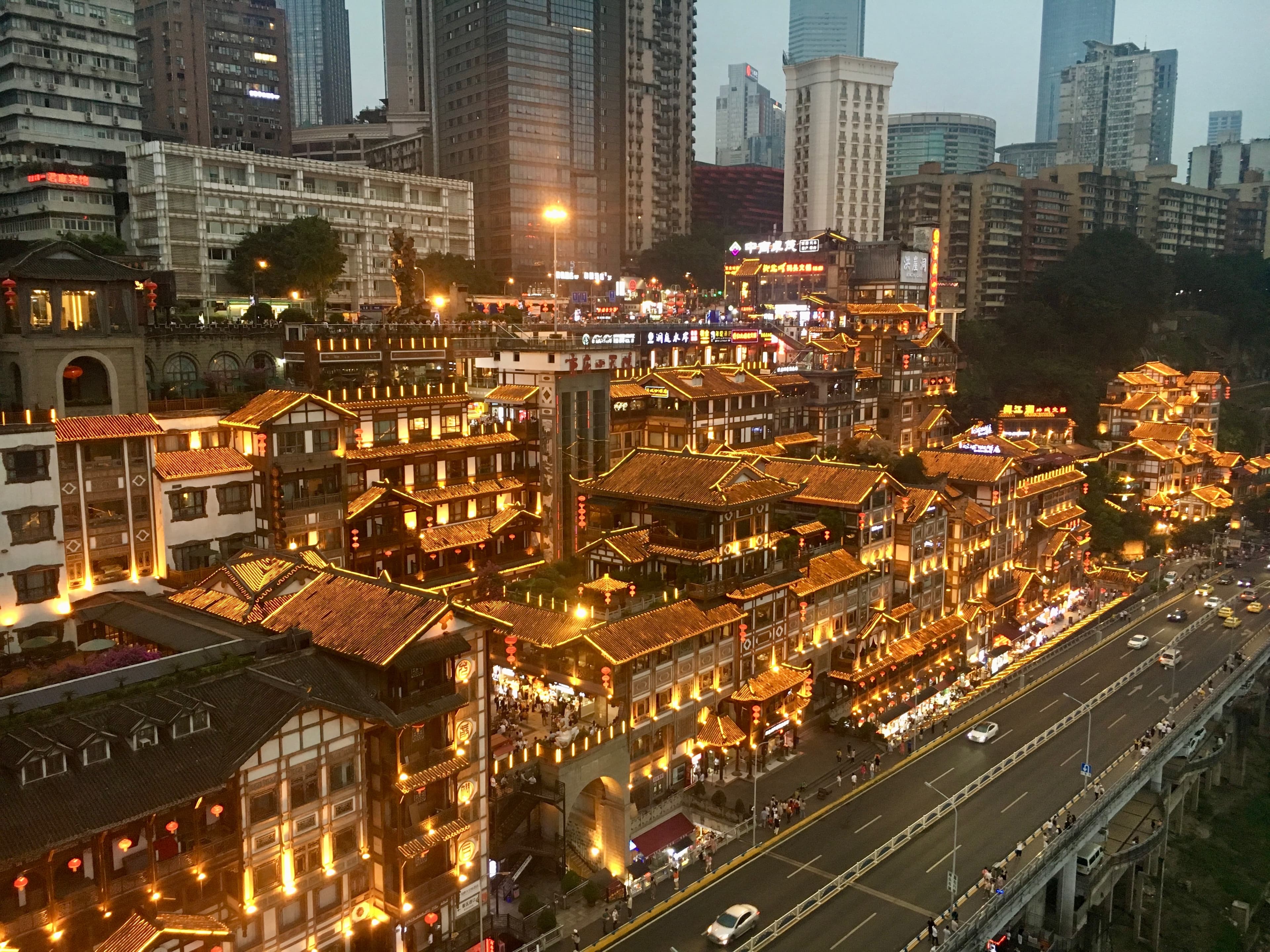
You have seen Hongyadong even if you do not know the name: eleven stories of timber stilt buildings cascading down a cliff to the Jialing River, lit gold after dark, compared endlessly to the bathhouse in Spirited Away.
Here is the part the photos never mention. The glowing complex you are looking at is not ancient. It was completed in 2006. The site is genuinely old, a fortress and city gate going back some 2,300 years to the ancient Ba kingdom, and the diaojiaolou stilt-house style it copies is a real centuries-old regional tradition. But the building itself is a modern reconstruction, and knowing that changes how you read it. This is not a preserved relic. It is a city choosing to rebuild its own memory at full scale.
The best trick is spatial. Depending on which street you walk in from, you can enter Hongyadong on what feels like the ground floor and find yourself eleven levels up, or eleven levels down. It is the entire logic of Chongqing compressed into one structure. I saw it in 2019 when it was crowded but not yet the national pilgrimage it has since become.
The infrastructure that felt like the future
What actually stayed with me was not a viewpoint. It was the trains.
Chongqing West Railway Station had opened in January 2018, so when I passed through in 2019 it was barely a year and a half old: 15 platforms, 31 tracks, high-speed lines fanning out across the southwest of the country. It felt less like a station than like a statement of intent.
Then there is the transit system itself. Chongqing runs the largest monorail network in the world, and its metro holds the records for both the highest and the deepest stations on the planet, on the same line. At Liziba, a monorail runs clean through the middle of a residential tower, doors on either side of the building. It is not a stunt. It is what happens when a city has no flat land and refuses to stop growing.
And it did not stop. In 2025 Chongqing opened what has been billed as the largest railway station in the world. Watching a place build itself at that speed, in real time, was the most genuinely futuristic thing I have seen in a decade on the road.
What Chongqing tastes like
You cannot write about this city without the pot. Mala hotpot, the numbing-and-spicy kind now copied across the world, was invented here by boatmen and wharf porters at the Chaotianmen docks, who simmered cheap offal in chili and Sichuan peppercorn to stay warm on the cold river. It went from survival food to the city's edible flag. Eat it at least once inside one of those old air-raid shelters, where the history and the heat share a room.
Why was Chongqing China's wartime capital?
After Japanese forces captured Nanjing and Wuhan, Chiang Kai-shek's Nationalist government moved up the Yangtze to Chongqing in 1938 and governed from there until the end of the war. The city's mountainous terrain made it defensible, and its distance from the coast put it beyond the reach of ground offensives, though not beyond the reach of bombers.
How big is Chongqing, really?
The municipality's population is over 30 million, which by administrative definition makes it the largest city proper on Earth. In practice most of that area is rural. The actual urban population is around 22 million, and the dense downtown core is closer to 8 or 9 million.
When is the best time to visit Chongqing?
Spring (March to May) and autumn (September to October) are the most comfortable, with clearer air and views. Avoid high summer if you can: Chongqing is one of China's so-called "furnace cities," and July and August regularly push past 40°C.
Where to stay in Chongqing
Base yourself on the Yuzhong peninsula near Jiefangbei and Hongyadong if you want the neon core within walking distance, or over in Shapingba near Ciqikou and the West Railway Station if you want the old town and easy high-speed rail out. Rates and options are mapped below.
These are affiliate links — booking through them supports Viator Modus at no extra cost to you. Same room, same price, it just helps keep the guides coming.
Go before it fully tips. The Chongqing I walked through in 2019 has already been replaced by a bigger one, and that one is going fast too.