East Asia
For eleven centuries Xi'an, then called Chang'an, was the eastern anchor of the Silk Road and one of the largest cities on Earth. It is where an emperor buried an army of clay to guard him forever, and where the trade routes that built it are still on the menu. I visited in September 2019.
Xi'an, China — the Terracotta Army and the Silk Road city, captured on my trip.
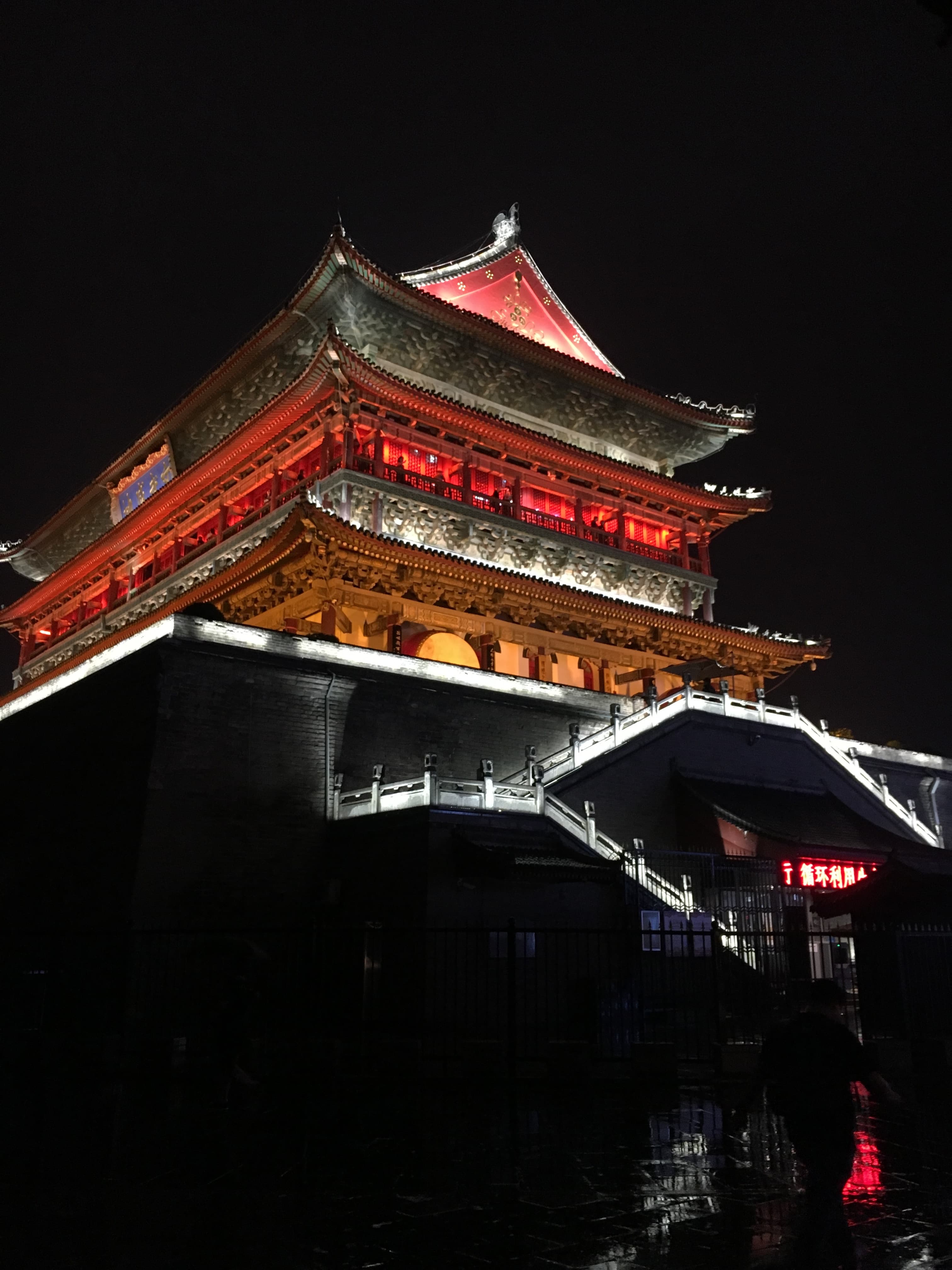
I visited Xi'an in September 2019, in the rain, which is how I remember most of it: red-lacquered towers glowing over wet streets, umbrellas everywhere, the smell of cumin and charcoal drifting out of the Muslim Quarter. It is not a city that most Western travelers put near the top of a China itinerary. It should be. Before Beijing, before Shanghai, before almost anything you associate with China, there was Chang'an, and this was it.
Here is what most people never quite grasp about the place: Xi'an was the capital of thirteen dynasties, and for the better part of a thousand years it was the eastern end of the Silk Road. Everything that came overland from Persia, India, and the Mediterranean ended here. So did the army.
The army in the ground
You already know the image. Rank after rank of life-sized clay soldiers, standing in trenches under a hangar the size of an aircraft factory. What the photos never convey is the silence of the scale. Pit 1 alone is roughly 230 meters long and holds an estimated 6,000 figures, of which around 2,000 have been excavated and re-erected. The total across all three pits is put at around 8,000 soldiers, plus 130 chariots and 670 horses.
They were built for Qin Shi Huang, the man who unified China and made himself its first emperor in 221 BCE. He began his own tomb complex almost as soon as he took the throne, and by the time he died in 210 BCE something like 700,000 conscripts had worked on it. The army was meant to guard him in the afterlife, arranged in real battle formation, facing east toward the territories he had conquered.
The detail that stays with me is that no two faces are the same. Standing at the rail you can pick out individual men: a moustache here, a topknot tied differently there, the officers taller than the infantry. They were originally painted in bright color, most of which flaked away within minutes of hitting the air after being buried for over two thousand years. What you see now is the bare terracotta, but up close, in the museum cases where a few of the best-preserved figures are displayed under glass, you can still read the craftsmanship: the laced armor, the knotted scarves, the calm, slightly unsettling expressions.
And here is the part that gets left out of the brochures: the emperor himself has never been dug up. His actual burial mound, a grassy hill a couple of kilometers from the pits, sits unexcavated to this day. The ancient historian Sima Qian wrote that it contains rivers of mercury flowing across a map of the empire, and soil surveys have in fact found unusually high mercury concentrations in the mound. Nobody has opened it. The technology to excavate it without destroying what is inside does not really exist yet, so it waits.
The other terracotta army, the fake one
A warning worth the price of the article. Xi'an has a small industry of counterfeit terracotta warriors, and I don't just mean the fist-sized souvenirs sold at every stall.
For years, taxi drivers and rogue "guides" outside the train station have run a scam: they offer a cheap ride to the warriors and instead drop tourists at a replica exhibition much closer to town, a warehouse of modern reproductions dressed up to look like the real museum, then collect a commission and leave. People have walked around a shed full of brand-new clay copies genuinely believing they saw the 2,200-year-old original. The real site is the Emperor Qinshihuang's Mausoleum Site Museum, in Lintong District, about 40 kilometers east of the city center. If a driver is steering you somewhere much nearer, or the ticket price seems off, you are being taken to the knockoffs.
Which is its own small comment on the place. This is a city whose signature relic is so famous that a parallel economy exists purely to sell you a convincing fake of it.
Chang'an: the city at the end of the Silk Road
Rewind about a thousand years before the Ming towers you see today. Under the Tang dynasty, from the 7th to the 9th century, this city was called Chang'an, and it was arguably the largest and most cosmopolitan city on the planet, with a population estimated near a million inside its walls. It was laid out on a strict grid, the model that Kyoto and Nara in Japan would later copy, and its western market was the terminus of the Silk Road.
That is not a metaphor. Caravans that had crossed the deserts of Central Asia, the Persians, Sogdians, Arabs, and Turks who ran the trade, all ended their journey here. Chang'an held Buddhist monasteries, Nestorian Christian churches, Zoroastrian fire temples, and mosques, all at once, a thousand years before "multicultural" was a word anyone used. Goods moved west (silk, of course, but also paper and porcelain) and moved east in return: horses, jade, glass, spices, musical instruments, and religions.
The Big Wild Goose Pagoda, which still stands in the south of the city, was built in 652 to house the Buddhist scriptures that the monk Xuanzang carried back overland from India after a seventeen-year journey. The Silk Road was not only a trade route. It was how ideas walked.
What the Silk Road left on the plate
The best-preserved piece of that history in Xi'an is not a monument. It is the food.
The Muslim Quarter, centered on Beiyuanmen street near the Drum Tower, is the home of the Hui people, Chinese Muslims whose presence here traces directly back to the Silk Road merchants and soldiers who settled in Chang'an over a thousand years ago. Tucked inside it is the Great Mosque of Xi'an, founded in the Tang era, one of the oldest in China and built almost entirely in the style of a Chinese temple rather than anything you would recognize from the Middle East: courtyards, pavilions, and a minaret shaped like a pagoda.
You eat your way down those lanes. The signatures are all Silk Road cooking, spiced with the cumin and chili that came in over the same routes:
- Roujiamo: shredded, slow-stewed meat stuffed into a griddled flatbread, reasonably called China's oldest hamburger and, by some accounts, one of the oldest sandwiches anywhere.
- Yangrou paomo: a mutton stew you build yourself by crumbling a dense unleavened bun into the bowl. Deeply Central Asian, deeply warming, exactly right in the rain.
- Biangbiang noodles: hand-pulled belts of dough wide as a belt and slapped against the counter, named after a character so complicated it has more than fifty strokes and is essentially impossible to type.
None of this tastes like the Chinese food most Westerners grow up on, and that is the whole point. This is the cuisine of the land routes, of lamb and wheat and cumin, not rice and the coast. You are tasting the Silk Road.
The wall, the towers, and the rest
Xi'an is one of the only major Chinese cities that still wears its full defensive skin. The City Wall you can walk today is Ming, built in the 1370s on Tang foundations, roughly 14 kilometers around and wide enough on top to cycle a lap, which is exactly what you should do. It is one of the most complete ancient city walls left in the world.
At the center of the old town stand the Bell Tower and the Drum Tower, both from the 1380s, that once sounded dawn and dusk over Chang'an. Lit up after dark, marooned on their traffic islands with the scooters and cars streaming around them in the wet, they were the image of the city I kept coming back to. We did the main circuit (the warriors, the wall, the towers, the pagoda, the Quarter), and it holds together as a single story better than almost anywhere I have been: two thousand years of one city, still legible.
Where is the Terracotta Army, exactly?
The genuine site is the Emperor Qinshihuang's Mausoleum Site Museum in Lintong District, about 40 kilometers east of central Xi'an. The public bus 5 (306) from Xi'an Railway Station goes straight there, or a booked car and driver removes the guesswork. Ignore anyone at the station offering a suspiciously convenient shortcut.
Why was Xi'an so important historically?
Xi'an, as Chang'an, served as the capital of thirteen Chinese dynasties, including the Qin, Han, Sui, and Tang. For much of that span it was the political heart of China and the eastern terminus of the Silk Road, which under the Tang made it one of the largest and most cosmopolitan cities in the world.
When is the best time to visit Xi'an?
Spring (March to May) and autumn (September to October) are the most comfortable, with mild temperatures and a decent chance of clear skies. I went in September and got rain, which I loved, but summer here is hot and humid and winter is cold and gray, so the shoulder seasons are the safe bet.
Where to stay in Xi'an
Base yourself inside or right beside the Ming city wall, near the Bell Tower and the Muslim Quarter. Everything old is then within walking distance, and the wall itself becomes your morning run. Day trips to the warriors run east from here. Rates and options are mapped below.
These are affiliate links — booking through them supports Viator Modus at no extra cost to you. Same room, same price, it just helps keep the guides coming.
Go for the army, stay for the noodles. Xi'an is the rare place where the history and the dinner are the same thing.
For a very different side of the country, read next: my guide to Hong Kong and its harbour.
Found this useful?
If this guide helped plan your trip to Xi'an, you can help fund the next one.
Buy me a coffee →