Europe
An Old Town reconstructed from 18th-century paintings, a Soviet tower now looked down on by the tallest building in the EU, and a sandwich that is secretly the communist era on a wrapper. The Warsaw most travelers skip.
Scenes from Warsaw, from the rebuilt Old Town to a plate of pierogi, captured on my trips.
Most travelers give Warsaw a night, if that. They route through it on the way to Kraków and assume the capital is grey, rebuilt, and forgettable. That instinct is a mistake, and the skyline alone can prove it.
I have been to Warsaw four times now, in 2011, 2014, 2022, and 2026. The city I first walked into in 2011 barely resembles the one I left in 2026. Fifteen years compressed a transformation that took most European capitals a century. And almost none of it happened the way you would guess.
Here is the Warsaw most people skip, and why the ones who skip it are wrong.
Why was Warsaw's Old Town rebuilt from 18th-century paintings?
Start with a fact that sounds invented. Warsaw's Old Town is not old. During the 1944 Warsaw Uprising, Nazi forces systematically destroyed more than 85 percent of the city's historic center, dynamiting it building by building as a deliberate act of erasure. When the war ended, the medieval core did not exist anymore.
So the city rebuilt it from paintings. In the 1770s, an Italian artist named Bernardo Bellotto, who worked under his more famous uncle's name, Canaletto, had painted a series of near-photographic views of Warsaw as court painter to Poland's last king. Those canvases survived the war. Architects used them as blueprints, matching the plaster colors of the market square houses to the pigments on Bellotto's paintings and lifting rooflines and window shapes straight off the canvas.
Walk the Old Town Market Square today and you are, in a literal sense, standing inside an 18th-century painting rebuilt at full scale. In 1980, UNESCO added it to the World Heritage List, the only entry ever admitted specifically as a near-total reconstruction rather than an original. Critics at the time called it a fake. UNESCO decided the act of rebuilding was itself the heritage worth protecting.
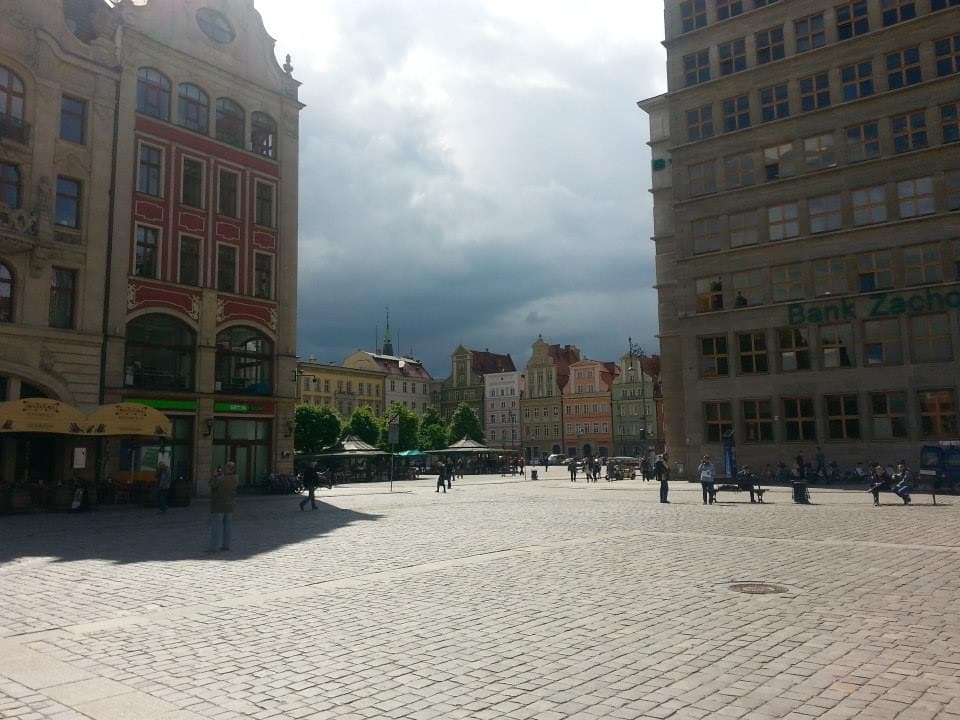
Warsaw is not the only Polish city rebuilt from the rubble of the war. Wrocław, then the German city of Breslau, lost more than half its historic center in the 1945 siege and raised its great market square again facade by facade from prewar plans.
What is the Palace of Culture and Science, really?
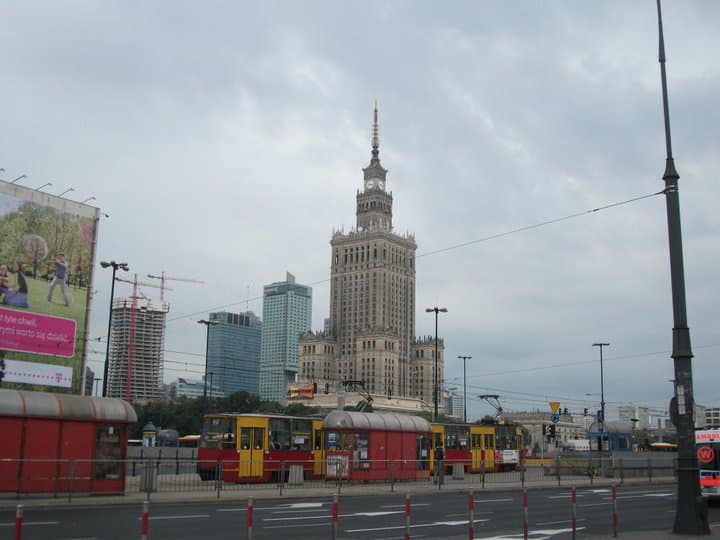
You cannot miss it, and for decades Warsaw wished you could. The Palace of Culture and Science is a 237-meter Stalinist tower that the Soviet Union handed Poland as a "gift" in 1955. Nobody in Warsaw asked for it. For 66 years it stood as the tallest building in Poland, looming over the center as a permanent reminder of who was in charge.
I walked its base on my first trip and again on my last, and by the second time the story had changed. In 2022, Varso Tower opened a few minutes away, 310 meters to its spire, now the tallest building in the entire European Union. From its observation deck at 230 meters, you look down on the Palace of Culture for the first time in the building's history. Warsaw spent 70 years trying to build its way out from under a Soviet monument. It finally did, and the view from the top is the whole story of the city in a single glance.
Is the Museum of Life Under Communism worth visiting?
Yes, and it is the fastest way to understand everything else in the city. The Museum of Life Under Communism (Muzeum Życia w PRL) sits beside Constitution Square, one of only two genuinely socialist-realist spaces in Warsaw. The other is the Palace of Culture itself.
It is small and deliberately low-tech, built around real objects instead of screens: a Fiat 126p, the tiny people's car Poles nicknamed the Maluch; a Frania washing machine; apartments recreated exactly as a 1970s family would have lived in them. I went expecting kitsch and left with context. You cannot read the rest of Warsaw, the block housing, the old vending machines, even the food, until you have seen how people actually lived here between 1944 and 1989.
What should you eat in Warsaw?
Start with the food that is secretly a history lesson. The zapiekanka, a toasted half baguette loaded with mushrooms, cheese, and a stripe of ketchup, is not an ancient Polish recipe. It was invented in the 1970s under party leader Edward Gierek, who had worked the mines of France and Belgium as a young man and came home partial to the baguette. He licensed French-style baking and eased the rules on private food stalls, and a cheap hot sandwich built from whatever was in stock fed a country standing up through years of shortage. You are eating the communist era off a paper wrapper.
Then the classics. Barszcz, the deep red beet soup, is clean and sharp and turns up in every form from a clear broth to a full bowl. Pierogi, Poland's dumplings, come stuffed with almost anything, but order the ruskie, potato and farmer's cheese, the version locals reach for first. And the vodka is real and it is everywhere. Poland has been distilling it for centuries, and a night out in Warsaw will make that history very clear.
What is there to do in Łazienki Park?
One quick correction, since the names get mixed up: the great green space most people mean is Łazienki Park, the Royal Baths, and Belweder Palace sits right at its edge. At 76 hectares, Łazienki is the largest park in Warsaw. It was once the summer estate of Stanisław August Poniatowski, Poland's last king, who turned a baroque bathing pavilion into the Palace on the Isle, set on its own lake.
The reason to come is the Chopin Monument. Free open-air Chopin recitals have been held beside it every summer weekend since 1959, played on a grand piano in the open air with the audience on the grass. Belweder Palace, on the park's edge, served as the residence of Poland's president through much of the 20th century. Come on a Sunday afternoon in summer, find the statue, and let the piano do the rest.
Where can you see Warsaw's football culture?
If you want the city with its guard down, go to a Legia Warszawa match. Legia is the most successful club in Polish history, founded in 1916 as the team of the Polish Legions, and the only Polish club never relegated since the Second World War. Its home, the Polish Army Stadium (Stadion Wojska Polskiego) on Łazienkowska Street, holds just over 31,000, and its home end, the Żyleta, or "Razor," is the club's famously intense terrace. I went to see the ground on an early trip and it stuck with me longer than half the museums did. This is where you feel the city rather than observe it.
Where to stay in Warsaw
Base yourself in Śródmieście, the central district, and you can walk to the Old Town, the Palace of Culture, and Łazienki, with the riverside nightlife a short ride away. Staying central also puts you beside Warszawa Centralna, the vast modernist station that opened in 1975, where I first arrived from Berlin late at night on my very first trip, before a taxi sped me across a city I did not yet understand.
That first arrival was 2011. The Warsaw I keep coming back to is not the one I landed in, and that is exactly the point. Give it more than a night.
Use the map below to compare stays across the Old Town, the center, and the riverside.
These are affiliate links — booking through them supports Viator Modus at no extra cost to you. Same room, same price, it just helps keep the guides coming.
Found this useful?
If this guide helped plan your trip to Warsaw, you can help fund the next one.
Buy me a coffee →