Middle East
Most travelers skip Amman on the way to Petra. Here's the firsthand case for the Jordanian capital: the Citadel's stacked empires, the 9,000-year-old statues of 'Ain Ghazal, and where to eat mansaf.
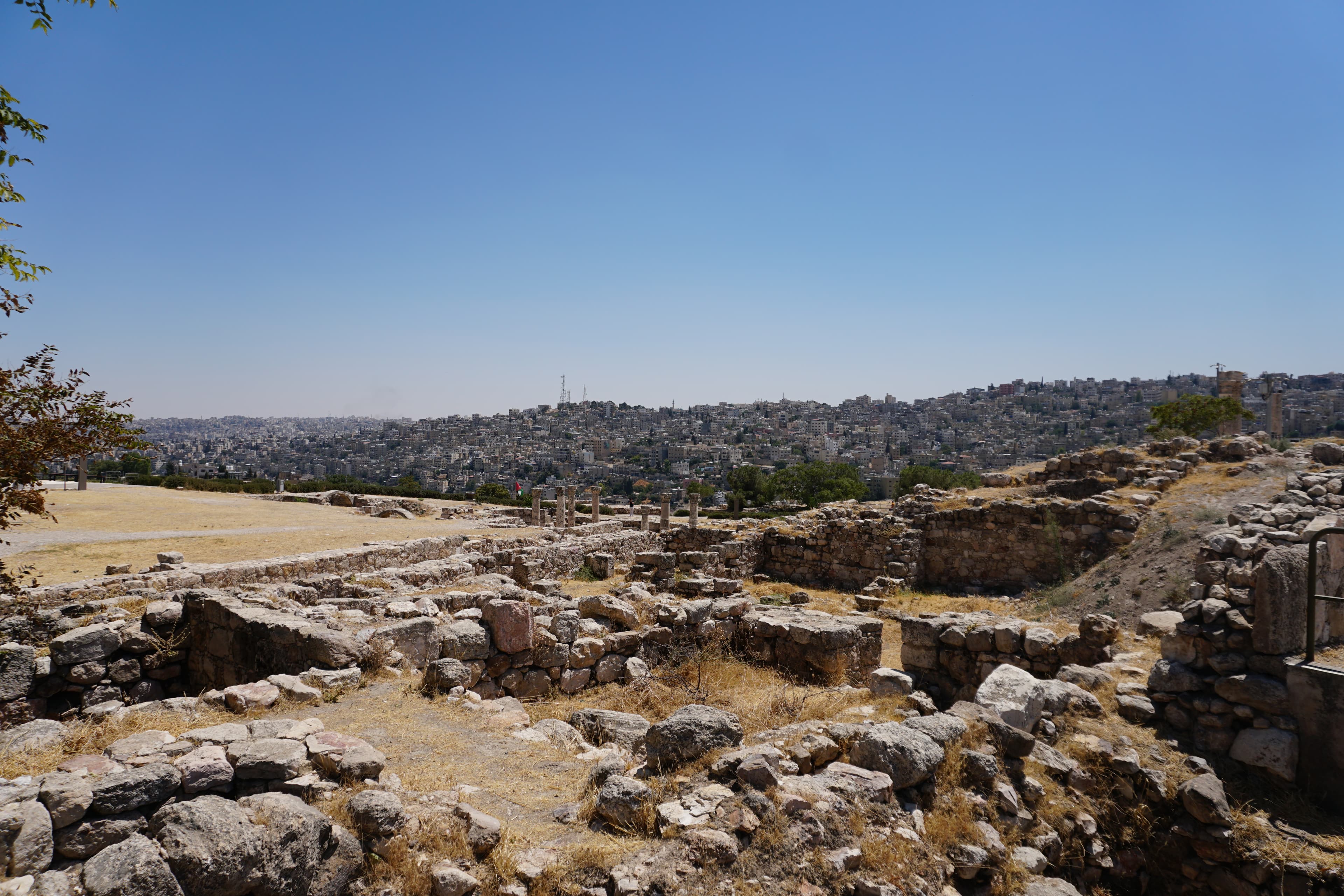
Scenes from Amman, from the Citadel hill to Rainbow Street, captured on my trip.
Amman does not look old. From the road it reads as a sprawl of pale limestone boxes climbing hill after hill. But the oldest large-scale human statues ever made were dug out of the ground here, and the city underneath your feet has been lived in for something like nine thousand years. This is a place that rewards knowing what you are looking at. I spent my time split between two of its hills and left convinced it is one of the most underrated capitals in the Middle East.
How many hills is Amman built on?
Amman began, like Rome, on seven hills. Today it spreads across more than nineteen of them, each one a jabal with its own name and character. The city has worn three names across its life: Rabbath-Ammon, capital of the biblical Ammonites; Philadelphia, after the Greek ruler Ptolemy II Philadelphus renamed it in the third century BC; and finally Amman, restored after the Arab conquest of 635 AD. Occupied continuously since the Neolithic, it counts among the oldest continuously inhabited places on Earth. Almost nobody outside the region thinks of it that way.
What is the oldest thing you can see in Amman?
In the 1980s, road crews on the edge of Amman cut into a Neolithic village called 'Ain Ghazal, which means "spring of the gazelles." Buried beneath the floors of long-abandoned houses were caches of human figures built from lime plaster over reed frames, staring up with wide bitumen eyes. They are roughly nine thousand years old, and they rank among the oldest large-scale representations of the human form ever discovered. You can stand in front of them today at the Jordan Museum downtown. A near-complete example sits in the Louvre in Paris. Most visitors to Amman never learn they exist.
What should you see at the Amman Citadel?
The Citadel crowns Jabal al-Qala'a, the highest hill in the city at around 850 meters, and it is where Amman's layers stack most visibly. In a single walk you pass the Roman Temple of Hercules, a Byzantine church, and the domed Umayyad Palace, empires piled directly on top of one another. Below, in the valley, the Roman Theatre cuts into the hillside with seating for six thousand people. It was built in the second century AD, and Ammanis still fill it for concerts today, close to nineteen hundred years later.
Which neighborhood should you stay in?
I split my stay between Jabal Amman and Jabal Al Lweibdeh, and Lweibdeh is, in my opinion, the best neighborhood in the city. Its leafy streets radiate off Paris Circle and are lined with galleries and sidewalk cafes that would not feel out of place in Europe. I ate at Faisal Cafe and could have stayed all afternoon. Over on Jabal Amman I stayed at the InterContinental Jordan, which turned the trip briefly absurd: they named me "Ambassador for the Day" and upgraded me to the presidential suite. Not a normal Tuesday.
These are affiliate links — booking through them supports Viator Modus at no extra cost to you. Same room, same price, it just helps keep the guides coming.
Where do you eat Mansaf in Amman?
Mansaf is Jordan's national dish, and it is not subtle. Lamb is slow-cooked in jameed, a tangy fermented dried yogurt, then piled over rice and paper-thin shrak bread and finished with almonds and pine nuts. It is traditionally served on one large communal platter and eaten with the right hand. The dish traces back through Bedouin and Moabite tradition for thousands of years, and in 2022 UNESCO added it to its list of the Intangible Cultural Heritage of Humanity. I had mine at Mansaf AlBalad, and it is the one meal I would tell you not to skip.
What is the best way to spend an evening in Amman?
Rainbow Street, running along Jabal Amman near the First Circle, is where the city comes out at night. The old villas along it have become cafes, shops, and restaurants. I ended a night with shisha at Old View, just off the street, watching the lights climb the surrounding hills. It is the kind of slow evening that makes Amman click into place: a modern city sitting directly on top of nine thousand years of history.
Amman asks a little more of you than most capitals. Come knowing what those hills have held, from the plaster watchers of 'Ain Ghazal to a Roman theatre still in use, and it becomes one of the most rewarding cities in the region.
Found this useful?
If this guide helped plan your trip to Amman, you can help fund the next one.
Buy me a coffee →