Southeast Asia
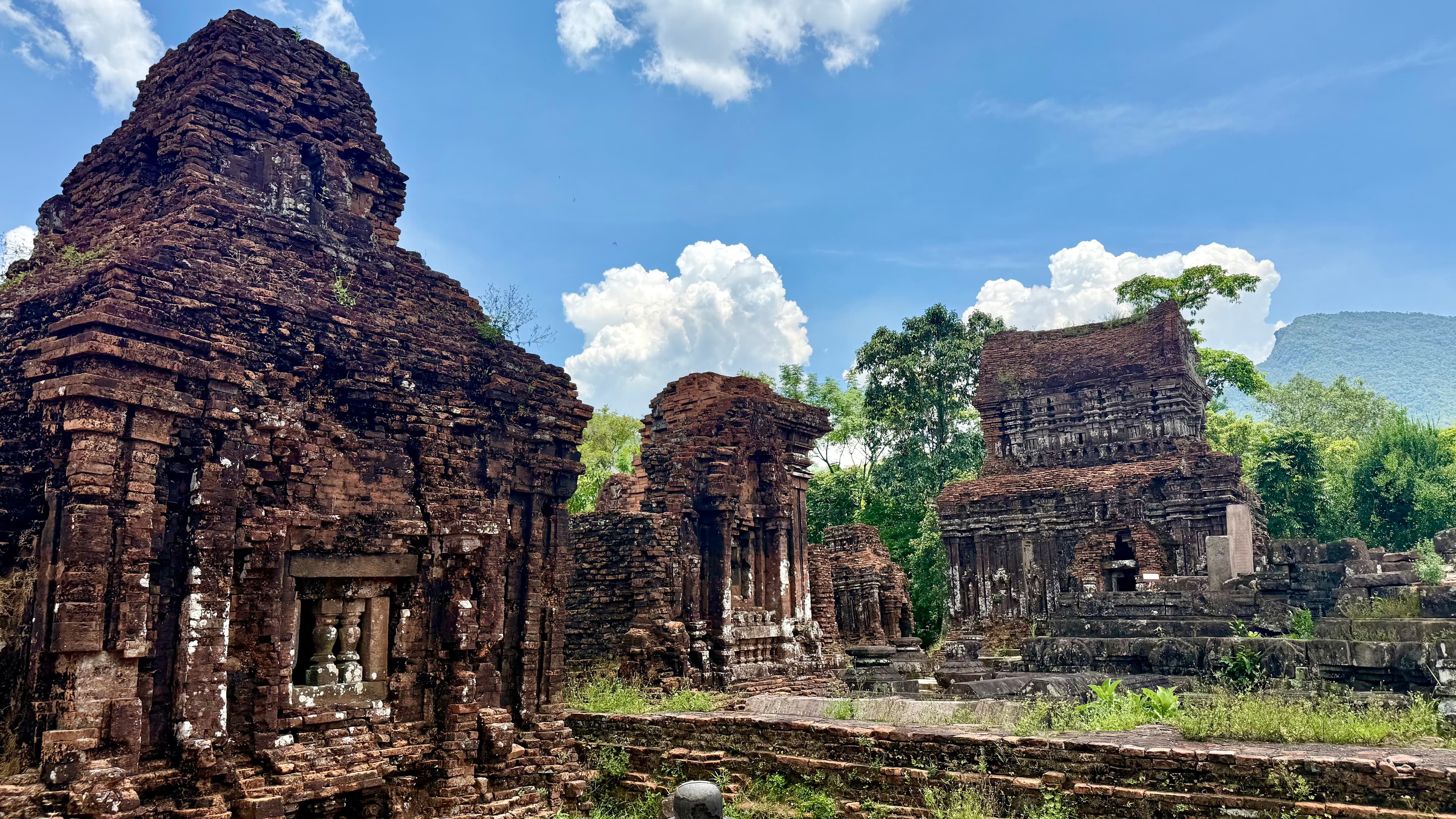
An hour inland from Hoi An and Da Nang, My Son was the spiritual capital of the Hindu Champa Kingdom: brick towers older than Angkor Wat, mortarless masonry no one has fully explained, and a valley still scarred by the bombing of 1969.
Most travelers on Vietnam's central coast never make it past Hoi An's lantern-lit old town. An hour inland, in a jungle valley ringed by mountains, sits the spiritual capital of a Hindu kingdom that ruled this coast for over a thousand years. The ruins its kings left behind are older than Angkor Wat. I rented a scooter in Da Nang and rode out to see them myself.
How do you get to My Son from Da Nang or Hoi An?
I made the ride out from Da Nang on a rented scooter, roughly an hour and fifteen minutes each way. The drive is half the reason to do it: the road winds through open rice fields and low green hills that the tour buses blow straight past. If you'd rather not drive, organized tours run daily from both Hoi An and Da Nang, and a Grab or Xanh (Vietnam's ride-hail apps) will take you door to door from either city. Hoi An is the closer base at around 45 minutes; Da Nang adds a little more road but gives you the rice-field scenery.
What does My Son cost, and when should you visit?
As of July 2026, entry is 150,000 VND for foreign visitors, a little under 6 USD. Go early. The valley sits in a natural bowl with almost no shade over the ruins, and by late morning the heat is punishing. Mornings do bring more crowds, so it's a real tradeoff: arrive close to opening and you'll share the site with more people, but you'll sweat far less walking between the temple groups. I'd take the cooler morning every time.
Who built My Son, and when?
My Son was the religious heart of the Champa Kingdom, a Hindu civilization that ruled central and southern Vietnam from roughly the 2nd century to the 17th. The first temples went up here in the 4th century under King Bhadravarman, who dedicated the site to Shiva, worshipped locally as Bhadreshvara. Those earliest shrines were wooden and burned in a fire around 535 AD. The brick towers standing today were raised and rebuilt across the centuries that followed, with construction continuing into the 13th century.
Put that timeline against Angkor Wat, which went up in the 12th century, and the scale lands: the first sacred building at My Son predates Cambodia's famous temple by around 700 years. French archaeologists rediscovered the overgrown site in 1898 and spent the early 1900s cataloguing more than 70 brick towers hidden in the jungle.
What happened to My Son during the Vietnam War?
By the late 1960s, the same defensible valley that made My Son sacred made it useful. Viet Cong forces used the ruins and surrounding jungle as a base. In one week of American carpet bombing in August 1969, most of the site was flattened. The largest and finest temple here, tower A1 in Group A, stood around 90 feet tall and was considered the single greatest work of Cham architecture in Vietnam. It held out through the week of bombing until a direct load of bombs finally brought it down.
Of the 70-plus towers the French had catalogued, only about 20 survived the war. Bomb craters still scar the ground between the temple groups, and unexploded ordnance remains in the unexcavated areas, which is exactly why you stay on the marked paths. Walking through, the war and the wonder sit side by side.
How were the temples built without mortar?
Here's the detail that stays with you. The Cham fitted their fired bricks so tightly that the towers hold together with little or no visible mortar, and those bonds have survived more than a thousand years of monsoon and heat. Nobody has definitively cracked how they did it. The leading theories point to a plant-resin adhesive, or a mortar made from the same clay as the bricks themselves, with the carvings cut directly into the finished walls. It remains a genuine open question, and standing next to a seam you can barely find, you feel it.
Where should you stay near My Son?
You don't stay at My Son itself; it's a half-day trip. Most travelers base in Hoi An for the old town or Da Nang for the beach and the airport, then day-trip in from either. Here's a map to sort out where to book:
These are affiliate links — booking through them supports Viator Modus at no extra cost to you. Same room, same price, it just helps keep the guides coming.
The Champa didn't vanish. Their descendants, the Cham, are still one of Vietnam's ethnic minorities today. Most people ride past the turnoff on their way to Hoi An's lanterns and never know a thousand-year Hindu kingdom is sitting an hour up the road. Don't be most people.