Africa
Dakar sits on the Cap-Vert peninsula, the westernmost point of mainland Africa and the closest part of the continent to the Americas. Above the city stands the African Renaissance Monument, the tallest statue in Africa, while the beaches below fill with thousands of hand painted pirogues from one of the world's largest artisanal fishing fleets. The old Yoff airport was once a transatlantic refueling stop for Concorde and a NASA Space Shuttle abort site, and a short ferry offshore lies Gorée Island, a UNESCO memorial to the Atlantic slave trade. I had only a few hours on the ground here in 2010, and it was enough to want to come back.
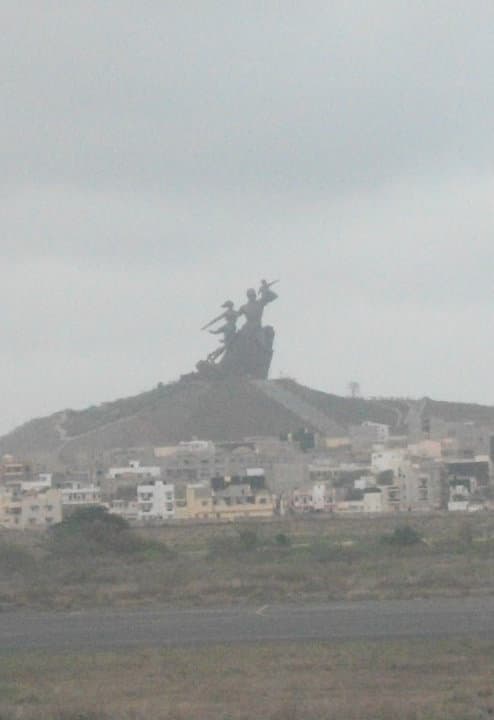
On July 3, 2010, I had a few hours on the ground in Dakar. We came in low over the water at the old Yoff airport, close enough to read the whole city on the sand: fishermen bent over the morning catch, rows of hand painted boats pulled up on the beach, and on the hill above them a colossal bronze figure that had been standing for barely three months. That figure was the African Renaissance Monument, and almost everything worth knowing about Dakar is visible in that single view. Here is what most travelers miss about the westernmost city on the African continent.
Where is Dakar and why does its location matter?
Dakar sits at the tip of the Cap-Vert peninsula, the westernmost point of mainland Africa. Pointe des Almadies, at the peninsula's northwestern edge, is as far west as the continent reaches, roughly 8 degrees further west than mainland Europe's westernmost point in Portugal. The peninsula is also the closest part of Africa to South America, about 2,800 km from the Brazilian coast, which is exactly why it became one of the most strategic crossings of the 20th century. Portuguese sailors named it Cabo Verde, or Green Cape, for its vegetation. The Cape Verde islands 570 km offshore were named after this peninsula, not the reverse.
What is the giant statue on the hill above Dakar?
That is the African Renaissance Monument, and it is the tallest statue in Africa. The bronze figure of a man, woman, and child rises roughly 50 meters (about 160 feet) from a hilltop in the Ouakam district, standing taller than the Statue of Liberty. It was unveiled in April 2010 to mark the 50th anniversary of Senegal's independence from France, which is why it was only months old the day I flew past it. The detail almost no one knows: it was built by Mansudae Overseas Projects, the North Korean state studio responsible for monuments across the continent. An elevator runs up through the figure to a viewing platform inside the man's head, more than 100 meters above the Atlantic.
Why is the beach full of brightly painted boats?
Those are pirogues, the long wooden canoes that define the Senegalese coast. Senegal operates one of the largest artisanal fishing fleets on Earth, with more than 20,000 pirogues in service, each hand painted with the colors and motifs of the family that owns it. This is not staged for visitors. Small scale fishing supplies up to 75 percent of the animal protein Senegalese people eat and employs over half a million people. The best places to see it are Soumbédioune's horseshoe bay, the main boatyard where the pirogues are actually built, and Yoff, the fishing district right beside the old airport, which is the exact beach I watched come to life on the way in.
What is the story behind the old Dakar airport?
This is the part guidebooks skip entirely. The airport I landed at, Léopold Sédar Senghor International (long known as Dakar-Yoff), was once one of the most important refueling stops in the world. Because Dakar is the closest African point to the Americas, it served as a critical transatlantic ferrying point in World War II. From 1976 to 1982, Air France Concordes stopped here to refuel on the Paris to Rio de Janeiro route. And through the 1980s, NASA designated Dakar an emergency Transoceanic Abort Landing site for the Space Shuttle, one of only a handful of runways worldwide cleared to receive a shuttle forced to abort after launch. The airport carries the name of Léopold Sédar Senghor, Senegal's first president, who was also a celebrated poet and the first African elected to the Académie française. It closed to passenger traffic in 2017 when the new Blaise Diagne airport opened about 45 km east, so if you fly to Dakar today, you will not arrive where I did.
Is Gorée Island worth visiting?
Yes, and it is the most sobering thing you can do near Dakar. Gorée is a small island about 3 km offshore, ruled in turn by the Portuguese, Dutch, English, and French, and a UNESCO World Heritage Site since 1978. Its House of Slaves (Maison des Esclaves), built in 1776, and its Door of No Return are among the most recognized memorials to the Atlantic slave trade anywhere. One honest note that most accounts leave out: historians actively debate how many enslaved people actually passed through Gorée itself, with credible estimates ranging from tens of thousands to far higher numbers. The scholarly view is that its power today lies in remembrance and reflection rather than in being the single largest departure point. That does not diminish the visit. A 20 minute ferry from the city center gets you there.
What else should you know before visiting Dakar?
The Dakar Rally was named after this city. The race ran from Paris to Dakar for three decades, finishing near the salt flats of Lac Rose just outside town, before security concerns moved it to South America in 2009 and eventually to Saudi Arabia. Lac Rose itself (Lake Retba) can turn a strawberry pink in the dry season from salt loving microalgae. And practically speaking, Dakar makes an unusually rewarding layover: if your flight connects here, even a half day is enough to see the monument, the fishing beaches, and a working West African capital that most long haul travelers only ever glimpse from the air, which is exactly how I first saw it. If I were connecting through Dakar today, I'd check Senegal's current advisory in Farhaven before leaving the airport.
Where should you stay in Dakar?
The map below shows current hotels and rentals across Dakar, from the Almadies and Ngor coastline near the old airport to the Plateau downtown.
These are affiliate links — booking through them supports Viator Modus at no extra cost to you. Same room, same price, it just helps keep the guides coming.
Found this useful?
If this guide helped plan your trip to Dakar, you can help fund the next one.
Buy me a coffee →