Europe
Helsinki is the Daughter of the Baltic, a neoclassical capital that Russia built to look like St. Petersburg and that Finns filled with saunas, sea fortresses, and quiet good design. Founded in 1550 as a trading rival to Tallinn, it only became a capital in 1812, and it wears that layered Swedish-then-Russian-then-independent history everywhere you look. I first came in August 2013 by ferry across the Gulf of Finland, and returned in August 2022 to find a city that had changed just enough to be worth a second look.
A few days in Helsinki on the Baltic, captured on my trip.
I've arrived in Helsinki two ways: once on the ferry from Tallinn across the Gulf of Finland, and once flying straight into the airport. Both times it was August, nine years apart, in 2013 and again in 2022, and both times the city felt like the calmest capital in Europe. Helsinki is the "Daughter of the Baltic," a place founded in 1550 by King Gustav Vasa of Sweden as a trading town to rival Tallinn, which sat just across the water. For its first few centuries it was a backwater. Then in 1812, three years after Sweden lost Finland to Russia, the Tsar moved the capital here from Turku because it was closer to St. Petersburg, and had the whole center rebuilt in grand neoclassical style to match the imperial capital. That is why Helsinki has doubled for Soviet Moscow and Leningrad in so many Cold War films, and why the heart of the city looks the way it does.
Things to Do
A traditional Finnish sauna is the one thing you should not leave Finland without doing. This is not a spa add-on here; it is the national institution. Finland has roughly 3.3 million saunas for a population of about 5.5 million people, which works out to more saunas than cars, and the word "sauna" itself is Finnish, one of the few Finnish words that made it into everyday English. In 2020 UNESCO added Finnish sauna culture to its list of Intangible Cultural Heritage. On my 2013 trip I went to Kotiharjun Sauna in the working-class Kallio district, which opened in 1928 and is the last traditional wood-heated public sauna in the city, unchanged and gloriously no-frills. By my 2022 visit the waterfront had a new landmark, Löyly, a sharp wood-clad public sauna that opened in 2016 right on the Baltic, where the ritual is to sweat and then walk straight into the sea. Do both if you can: the old one for the history, the new one for the view.
The other must-do for me is the Ateljee Bar on top of Hotel Torni. "Torni" means "tower," and when it went up in 1931 it was the tallest building in Helsinki and stayed that way for decades. The hotel has a genuinely strange history: for a few years after the Second World War, the Soviet-led Allied Control Commission ran its operations out of the building while it oversaw Finland. Today the top-floor bar has a wraparound terrace, and the men's room, with its glass wall looking out over the rooftops, is one of the more famous toilets in Scandinavia. Get a drink up there at the end of the day and you'll see the whole layout of the city, cathedral domes and harbor and all.
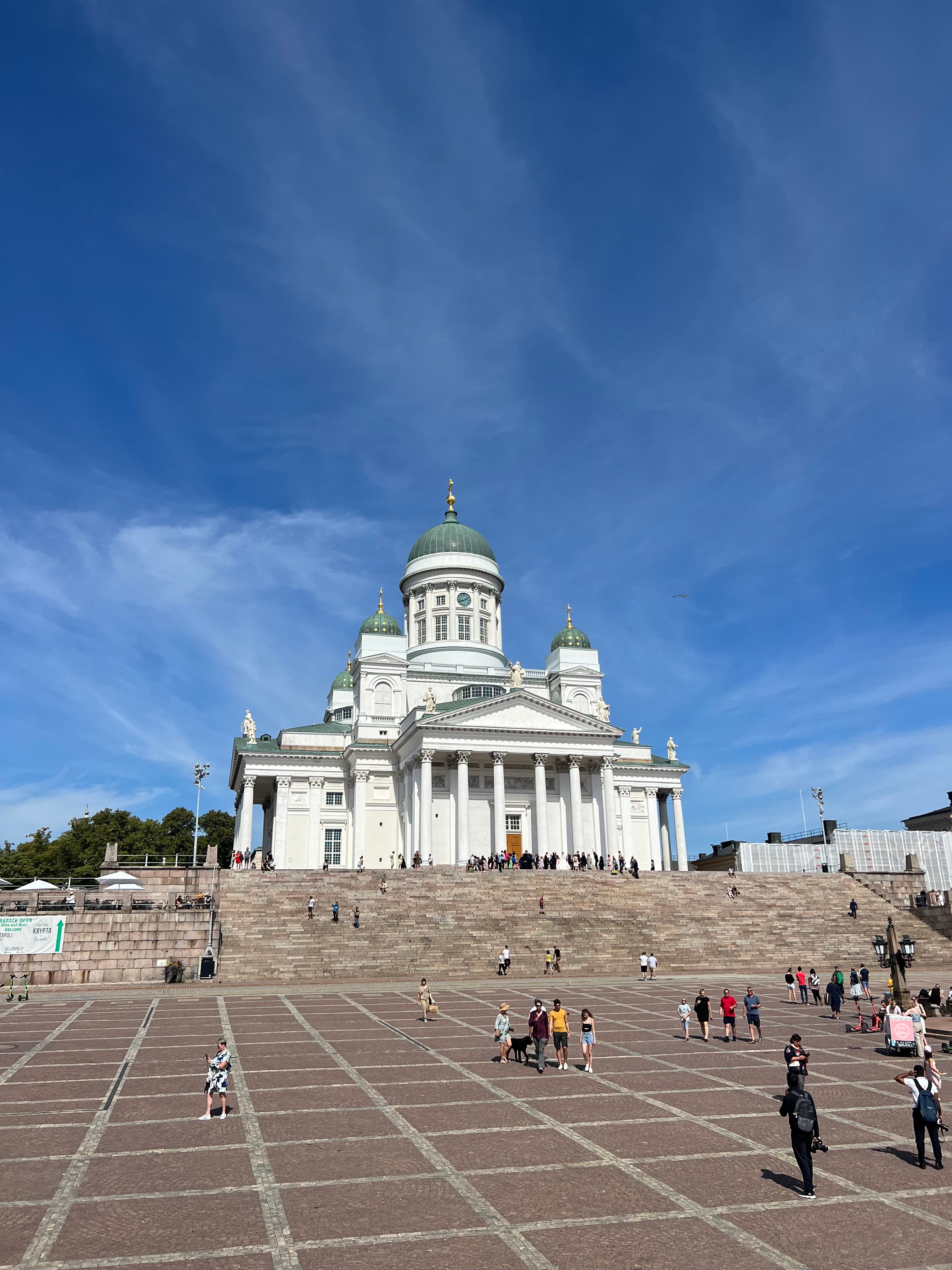
Down at street level, the centerpiece is Helsinki Cathedral, the white neoclassical church with the green dome that towers over Senate Square. It was designed by Carl Ludvig Engel, the German architect the Russians brought in to build the new capital, and finished in 1852, twelve years after Engel died. It was originally dedicated to Tsar Nicholas I as St. Nicholas' Church, and the twelve zinc apostles standing along the roofline were added at the end. The whole of Senate Square around it, the university and the government palace, is Engel's work too, and it is the most complete piece of that Russian-era imperial vision anywhere in Finland.
From there, stroll the Esplanadi, the tree-lined boulevard and park that runs from the square down toward the harbor. Laid out in 1818, "Espa," as locals call it, is where Helsinki comes out to sit in the sun in summer, with a statue of the national poet Runeberg in the middle and the old Kappeli restaurant, going since 1867, at the harbor end. It empties out right at the water, which is where the food is.
At the Market Square, the Kauppatori, on the harbor front, is where I ate reindeer. There are food tents set up along the quay in summer, and sautéed reindeer, a dish that really belongs to Lapland far to the north, is the thing to order, usually with mashed potato and lingonberry. Have a bowl of the salmon soup too. The Old Market Hall just beside it, built in 1889, is worth a wander for more of the same out of the weather.
Finally, get out to the islands. Helsinki sits on a scatter of them, and the one you cannot miss is Suomenlinna, the enormous sea fortress spread across six islands at the mouth of the harbor. The Swedes started building it in 1748 as Sveaborg, "the fortress of Sweden," to hold off the Russians; it fell to Russia anyway in 1808, and Finland renamed it Suomenlinna, "the castle of Finland," after independence. It's a UNESCO World Heritage Site now, one of the largest sea fortresses in the world, and around 800 people still live inside its walls. The public ferry out from the Market Square takes about fifteen minutes and runs on the same city transit ticket, so it costs almost nothing to go.
Best Time to Visit
Come in summer. I've only ever been in August and it's the sweet spot: mild, long evenings, and everything, the market tents, the terraces on Espa, the Suomenlinna ferries, running at full tilt. June brings the near-endless light of the far north if you want the white-nights version. Winter is the opposite extreme, dark and cold with only a few hours of daylight, though the Christmas market on Senate Square and a sauna-then-snow session have their own strong appeal if you're prepared for it.
Where to Stay
Base yourself in the compact center, around the Esplanadi, Senate Square, and the Design District, and you can walk to almost everything on this list. The harbor, the market, the cathedral, and the tram network are all within a few minutes.
Budget: CheapSleep Helsinki, a well-run hostel a short tram ride from the center with private rooms as well as dorms.
Mid-range: Hotel Torni, the 1931 tower itself, so you can take the elevator up to the Ateljee Bar and its rooftop terrace without ever leaving the building.
Luxury: Hotel Kämp, the grand 1887 landmark on the Esplanadi, old-world and central, long the place Helsinki put up its most famous guests.
These are affiliate links — booking through them supports Viator Modus at no extra cost to you. Same room, same price, it just helps keep the guides coming.
Getting Around
Central Helsinki is small and flat and best done on foot, but the tram network is excellent and part of the fun; the number 2 and 3 lines loop past most of the sights if your legs give out. Everything runs on the HSL transit system, and, crucially, the same single ticket covers the ferry out to Suomenlinna, so treat that island trip as just another leg of public transport. I've arrived both by air and by sea: the ferry from Tallinn crosses the Gulf of Finland in about two hours and drops you right in the harbor, while the airport sits about 20 kilometers north, connected to the central station by the ring-rail commuter train in roughly half an hour.
Hidden Gems
Skip the obvious islands once and take the ferry to Vallisaari instead, a former military island near Suomenlinna that only opened to the public in 2016 and is now overgrown, quiet, and full of old fortifications. Back in town, duck into the Temppeliaukio Church, the "Rock Church" blasted straight down into the granite in 1969, with a copper dome and remarkable acoustics. And spend an hour in the Design District: Finland's reputation for design, from Alvar Aalto to Marimekko, is not marketing, and the small shops and studios in the streets southwest of the Esplanadi are where you actually see it.
Found this useful?
If this guide helped plan your trip to Helsinki, you can help fund the next one.
Buy me a coffee →