Southeast Asia
Vietnam's Nguyen Dynasty capital. The Citadel and the Battle of Hue, the royal tombs, Thien Mu Pagoda's burning-monk car, an abandoned water park, and where Bun Bo Hue was born.
Most travelers give Hue a single afternoon on the train line between Hoi An and the north. For a city that ran Vietnam for 143 years, that is a strange thing to do.
Hue was the seat of the Nguyen Dynasty, the last royal family to rule a unified Vietnam. From 1802 to 1945, every emperor lived, ruled, and was buried here. The result is a city with a walled imperial citadel, a river lined with emperor tombs, and a food culture built to feed a royal court. It also carries some of the deepest scars of the Vietnam War, and, on its outskirts, one of the strangest abandoned places in Southeast Asia.
Here is what most people miss.
Why was Hue the capital of Vietnam?
In 1802, Emperor Gia Long unified the country under the Nguyen Dynasty and made Hue his capital. Thirteen emperors would rule from here over the next 143 years, until the last of them, Bao Dai, abdicated in 1945 and the imperial era ended.
That century and a half is why Hue matters. It was the political, religious, and cultural center of the country. When Vietnam earned its first UNESCO World Heritage listing in 1993, it was the Complex of Hue Monuments that received it. Almost everything worth seeing here traces back to that stretch of imperial rule.
The Imperial City: a Forbidden City on the Perfume River
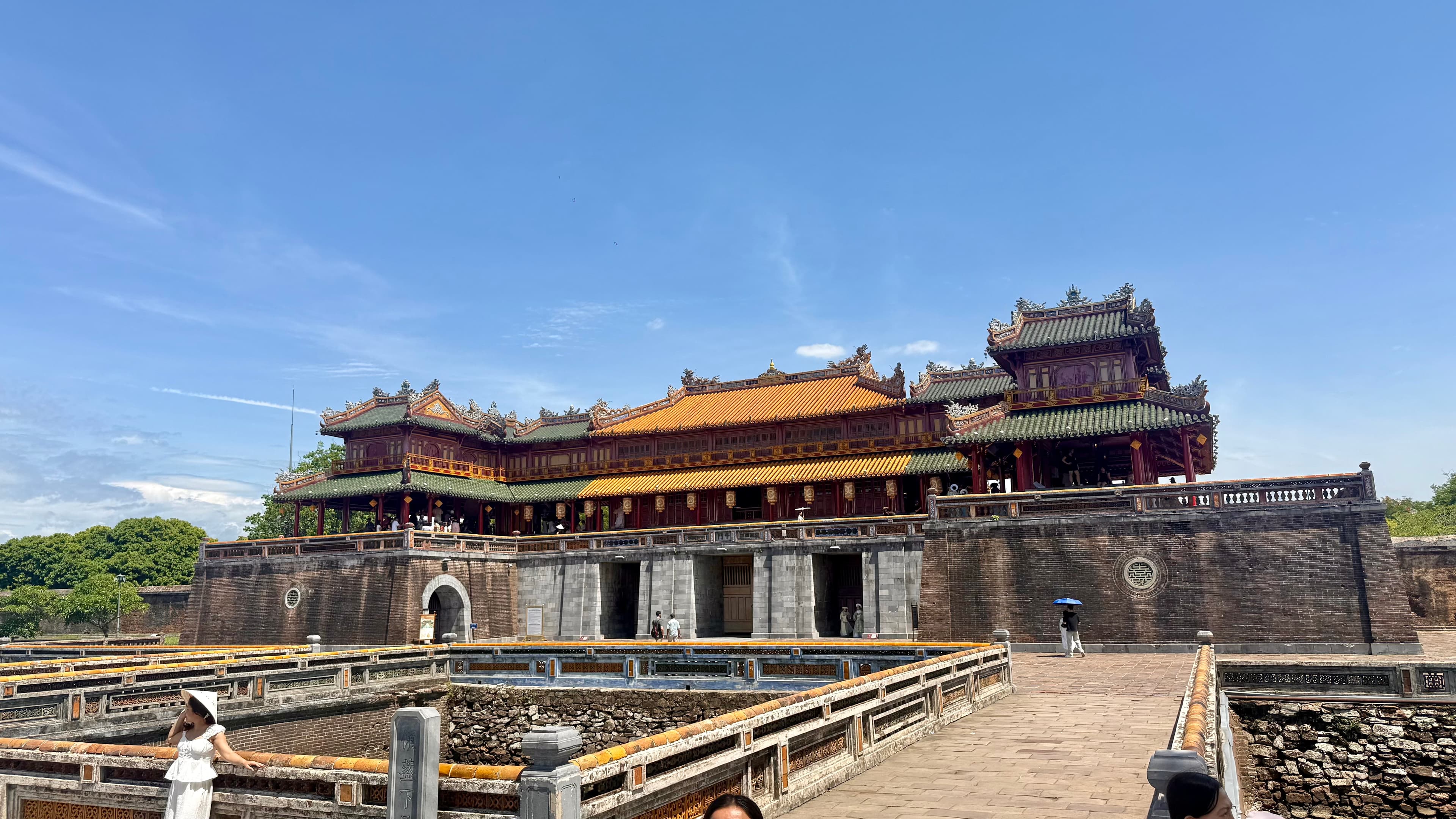
At the center of Hue sits the Citadel, a vast walled fortress begun in 1804 and modeled on Beijing's own Forbidden City. Inside its outer walls is a second enclosure, the Imperial City, and inside that, the Purple Forbidden City, once reserved for the emperor and his household alone.
What the palace tours tend to skip is what happened here in 1968. During the Tet Offensive, Hue became the site of the longest and bloodiest urban battle of the Vietnam War. The fight for the Citadel ran from 31 January to 2 March, over a month of house-to-house combat that left more than 10,000 dead and much of the city in ruins. Walk the walls today and you can still find bullet and shell scarring in the stone. The Imperial City you see now is part restoration, part ruin, and that contrast is the whole story.
The royal tombs: where the emperors chose to be remembered
Strung along the Perfume River south of the city are the tombs of the Nguyen emperors. Of the dynasty's 13 rulers, only 7 built tombs, and each was designed in the emperor's own lifetime as a retreat first and a burial site second.
The one to prioritize is the Tomb of Khai Dinh. Construction began in 1920 and took 11 years, the longest of any imperial tomb in Vietnam, finished in 1931 under his son, six years after Khai Dinh's own death. It is the smallest of the great tombs by area, yet it was the most expensive to build. Khai Dinh had visited France in 1922, and it shows. The exterior is dark, weathered concrete with an almost Gothic silhouette, built from imported iron, steel, and French slate. Step inside and it flips completely into an explosion of colored glass and porcelain mosaic. There is nothing else like it in the country. Minh Mang's tomb, by contrast, is all Confucian symmetry and water, and Tu Duc's is a landscaped retreat where the emperor actually lived before he died. If you only have time for one, make it Khai Dinh.
Thien Mu Pagoda and the car that changed the war
On a bluff above the Perfume River stands Thien Mu, the tallest pagoda in Vietnam, first built in 1601. It is a striking seven-tiered tower, and most visitors photograph it and move on. They walk right past what is parked behind it.
In a garage on the grounds sits a pale blue Austin sedan. In June 1963, that car drove the monk Thich Quang Duc to a Saigon intersection, where he sat down and set himself on fire in protest against the persecution of Buddhists. The photograph of his self-immolation went around the world. President Kennedy later said no news picture in history had generated so much emotion. The car is still here, with the famous photo displayed beside it. It is one of the most quietly powerful objects you can stand in front of anywhere in Vietnam.
Ho Thuy Tien: the abandoned water park with a dragon
About 8 km from the center, on the edge of Thuy Tien Lake, is one of the strangest places in the country. Ho Thuy Tien was built as a modern water park, opened in 2004 at a reported cost of around 3 million US dollars, and shut down within a couple of years. It was never really finished.
What is left is a giant concrete dragon rising out of the lake, its body wrapped in vines and graffiti, with a derelict aquarium in the dome beneath it. For years after it closed, crocodiles were reportedly left behind in the drained pools before they were finally removed. You can walk a bridge out to the dragon and climb the internal staircase to look out through its mouth over the water. Technically abandoned, informally open, and unlike anything else on a Hue itinerary.
Where was Bun Bo Hue invented?
Hue's status as the royal court gave it the most refined food culture in Vietnam, and its signature dish is Bun Bo Hue, a spicy beef and pork noodle soup that locals will tell you outclasses pho. Thick round rice noodles, a broth built on beef and pork bones, lemongrass, chili oil, and fermented shrimp paste. It is louder and more complex than its famous northern cousin.
Its origins trace to the 16th century and the Nguyen lords who first ruled from this region, which makes it one of the oldest noodle soups in the country. Exactly how it was born is genuinely debated. One account places it in the royal kitchens, cooked for the court before it ever reached the street. Another credits a woman remembered as Co Bun, a master noodle-maker whose village, Van Cu, still produces the dish's signature noodles more than 400 years later. Either way the through-line is the same: Bun Bo Hue is imperial cuisine that trickled down to the roadside stall, which is exactly where you should eat it.
Where to stay in Hue
Most of Hue's hotels cluster on the south bank of the Perfume River, walkable to the restaurants and a short ride from the Citadel and the tombs. The map below shows current options and live pricing.
These are affiliate links — booking through them supports Viator Modus at no extra cost to you. Same room, same price, it just helps keep the guides coming.
Final word
Hue rewards the travelers who give it more than an afternoon. It is the one place in Vietnam where you can stand inside a walled imperial palace, trace bullet holes from 1968, drive out to the emperor tombs, and end the day with a bowl of soup invented for royalty. Skip it and you have skipped the seat of the entire dynasty.
Found this useful?
If this guide helped plan your trip to Hue, you can help fund the next one.
Buy me a coffee →