Africa
The oldest university on Earth, the largest car-free city in the world, a caravan town 52 days from Timbuktu, and an Alpine village hiding in North Africa. A week across Morocco most travelers rush.
A week across Morocco, from Marrakesh to the Sahara to Fes and the Atlas, captured on my trip.
Most people do Morocco as a blur. A long weekend in Marrakesh, one photo on a dune, and back home. That version misses what the country actually is. I spent a little over a week there and crossed it end to end: Marrakesh, then south over the mountains to the edge of the Sahara, then north by train to Fes, then up into the Atlas to a town that looks like it was airlifted out of the Alps. In one week I ate goat tongue in a medieval square, got by in the desert entirely on hand gestures, and spent Christmas on a rooftop making pasta with strangers. Here is how the pieces fit together, and what almost everyone skips.
Why do they call Marrakesh the Red City?
Marrakesh was founded in 1070 by the Almoravids, and nearly everything built since has been the same color. The ramparts, the packed-earth walls, the old medina, all made from the local red sandstone. That is the Red City, and it is a rule the city still enforces on new construction today.
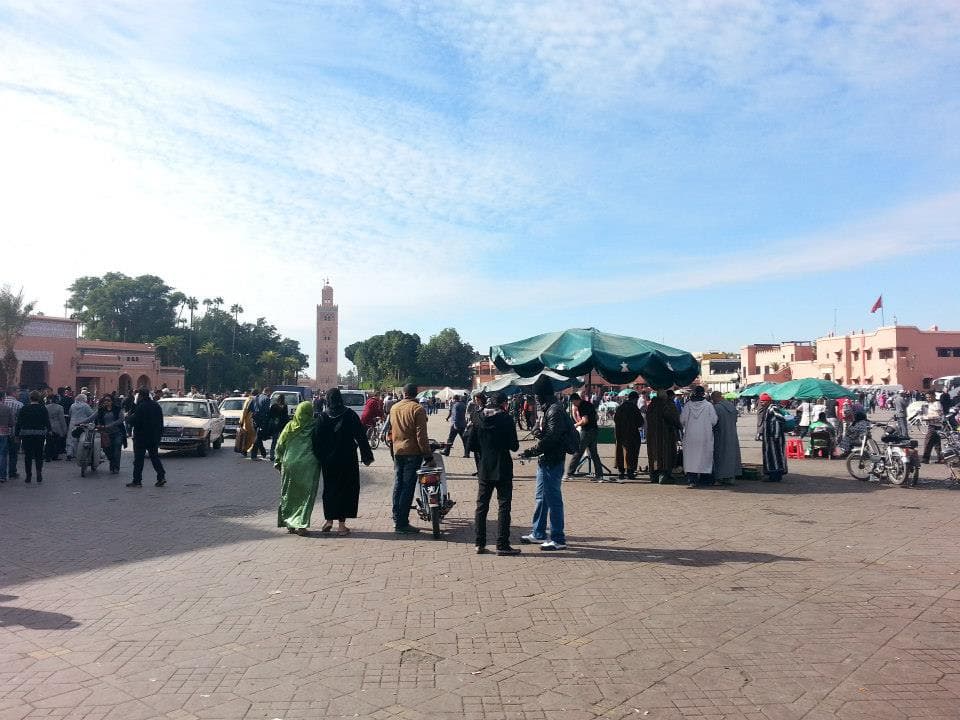
The center of it is Jemaa el-Fna, the main square. In 2001 it became one of the very first places on Earth named a UNESCO Masterpiece of the Oral and Intangible Heritage of Humanity. That designation was not for a building. It was for what happens in the square: the storytellers, the Gnawa musicians, the snake charmers, a live performance tradition that has run for centuries. UNESCO decided the performances themselves were worth protecting the way you protect a monument.
At night the square turns into open-air food stalls, and this is where I ate the strangest thing of the whole trip. Goat tongue, bought from a stall right in the middle of Jemaa el-Fna. The stall beside it was selling whole goat heads and brains. I thought about trying the brain, then thought about mad cow disease, and the tongue won. Above all of it stands the Koutoubia Mosque, the largest in Marrakesh, its 77-meter minaret begun by the Almohads in 1147. It became the template for the region: the Giralda in Seville and the Hassan Tower in Rabat were both modeled on it.
Is the Sahara worth the trip from Marrakesh?
My desert trip ran south to Zagora, the old caravan town at the southern edge of the country. Getting there is half of it. The road climbs out of Marrakesh and over the High Atlas, then drops into the Draa Valley, a 200-kilometer ribbon of date-palm oases strung along Morocco's longest river.
Zagora was the last real town on the trans-Saharan trade route, the point where camel caravans loaded up before crossing into West Africa. At the edge of town there is a famous painted sign that still says it plainly: Timbuktu, 52 days. That was the actual travel time by caravan, and it is the best single fact about the place. This was a departure gate for one of the great trade networks in human history.
Keep the scale in mind out there. The Sahara is the largest hot desert on the planet, larger than the entire country of Australia, and what you reach from Zagora is one sliver of its far western edge. The trip itself is a camel ride out to a Berber camp among the dunes for a night. I was the only English speaker on mine, so I got the whole thing, the guides, the meals, the small talk around the fire, in hand motions. The reason to do it is not the camel. It is the silence, and a star field with no city for hundreds of kilometers in any direction.
Why is Fes the world's largest car-free city?
From Zagora I went back north and took the train to Fes, and Fes is where Morocco gets old. Fes el-Bali, the walled medina, is the largest car-free urban area on Earth. Roughly 9,000 alleyways, most too narrow for anything wider than a loaded donkey, packed into about 300 hectares. GPS gives up in there. The maze was built to disorient invaders, and it works on tourists just as well. The medina has been continuously inhabited for over 1,200 years, founded by the Idrisid dynasty around 789 AD.
Inside it is the thing most travelers walk right past without knowing what it is. The University of al-Qarawiyyin was founded in 859 AD by a woman, Fatima al-Fihri, who built it with money she inherited from her father. Guinness World Records and UNESCO both recognize it as the oldest continuously operating, degree-granting university in the world. It is more than 200 years older than Oxford, and it has been teaching without interruption ever since.
Then there are the tanneries. The Chouara Tannery has run since the 11th century using more or less the same process it always has: stone pits full of natural dye, hides worked by foot. I can still recall the smell. It is unlike anything else I have ever encountered, and it does not leave you. Vendors on the balconies above hand you a sprig of mint to hold under your nose, and you understand why the second you arrive.
Fes is also where my favorite night of the trip happened, and it had nothing to do with any monument. It was Christmas, and I spent it on the roof of my hostel with a handful of other Europeans I had met there, drinking wine out of plastic bottles and cooking pasta. Not the Morocco anyone pictures. Exactly the reason to travel like this.
Are the Atlas Mountains actually worth it?
The Atlas Mountains were the biggest surprise of the country, and I did not expect to say that about Morocco. This might be one of the most underrated mountain ranges in the world.
The High Atlas is the serious part. Mount Toubkal, at 4,167 meters, is the highest peak in North Africa and the highest point for more than 2,000 kilometers in any direction. On a clear day you can see it from Marrakesh, and the ancient Greeks believed this entire range was the home of Atlas, the titan holding up the sky. The road south to the desert cuts straight over it.
The stranger side of the range is in the north. From Fes I split a local taxi with an Irishman from the hostel and we drove up to Ifrane, in the Middle Atlas. The French built it in the 1930s and modeled it on an Alpine village: red-roofed chalets, cedar forests, snow on the ground. They call it the Little Switzerland of Morocco, and it is regularly ranked one of the cleanest cities in Africa. Standing in the snow there, a day or two after being on a camel in the Sahara, it genuinely did not feel like the same country. That contrast, desert and snow in the same week, in the same country, is the thing I would sell anyone on.
Where to stay in Morocco
Base yourself in the medinas. A restored riad inside the old walls of Marrakesh or Fes puts you minutes from everything worth seeing, and the courtyard architecture is a large part of the experience. For the desert leg, book the Zagora camp through a tour out of Marrakesh, and if you head north, a hostel in the Fes medina is the move for the rooftop-and-strangers version of the trip.
Use the map below to compare stays across Marrakesh, Fes, the mountains, and the desert.
These are affiliate links — booking through them supports Viator Modus at no extra cost to you. Same room, same price, it just helps keep the guides coming.
Found this useful?
If this guide helped plan your trip to Morocco, you can help fund the next one.
Buy me a coffee →