South America
A firsthand account of the 4-day Salkantay Trek to Machu Picchu — why it beats the Inca Trail, a day-by-day breakdown, and how to reach Machu Picchu without trekking.
Most people who reach Machu Picchu take one of two roads. The classic Inca Trail is the famous one, the postcard one, the one that sells out months in advance. We took the other one.
The Salkantay Trek is longer, higher, and far emptier. It covers 74km against the Inca Trail's 42km, and it tops out at the Salkantay Pass at 4,630m (15,190ft), which is more than 400m higher than the Inca Trail's highest point at Dead Woman's Pass. It is consistently rated the tougher of the two. We chose it anyway, and the reason was simple: it is one of the only treks on Earth where you start on a glacier and end in the jungle.
Why we skipped the Inca Trail
The Inca Trail follows the original Inca stone path to the Sun Gate, and there is real history in that. But it is capped, permitted, and busy, and it moves through a narrower band of terrain.
Salkantay does something the Inca Trail can't. Over four days you drop from high alpine and glacial country, down through cloud forest, and into humid subtropical jungle. The landscape reinvents itself every few hours. You get snow-capped peaks, a turquoise glacial lake, coffee farms, and banana trees on a single itinerary. For us, the diversity of landscapes, the higher elevation, and the sheer range of climates made the decision easy.
The peak that names the trek, Salkantay Mountain, rises to 6,271m (20,574ft). In Quechua the name is often translated as "savage" or "wild mountain." It earns it.
Two nights in Cusco first
We flew into Cusco and gave ourselves two nights there before the trek, and I'd tell anyone to do the same or more. Cusco sits at roughly 3,400m (11,150ft). That is already high enough to flatten you if you arrive from sea level and start climbing the next morning.
Cusco was the capital of the entire Inca Empire, and it still feels like a capital. It is a genuinely fun little city, walkable, full of good food and Inca-era stonework built directly into the Spanish colonial buildings on top of it. It is also the natural jumping-off point for everything in the Sacred Valley, Machu Picchu included. Use the two days to eat, wander, drink the coca tea, and let your body catch up.
Day 1: Challacancha to Soraypampa, and a detour to Humantay Lake
Our operator, Salkantay Trekking (http://salkantaytrekking.com/), picked us up at 4am and drove us out to Mollepata, the staging town, before we started walking from Challacancha to Soraypampa.
The highlight of the day is a detour up to Humantay Lake, a glacial lake sitting around 4,200m. The water is an unreal turquoise, colored by glacial silt coming off the peaks above it. It's a steep climb to reach it, which is a useful preview of what day two has in store.
That night we slept in an igloo-style dome at Soraypampa. With no light pollution for miles and clear high-altitude air, we got one of the best views of the Milky Way I've ever seen, arcing right across the sky over the mountains. That alone was worth the first day.
Day 2: Over the Salkantay Pass at 15,190ft
This is the hard one. Day two is the highest and most strenuous day of the trek, a long grind up to the Salkantay Pass at 4,630m (15,190ft), the top of the whole route.
At that altitude every step is deliberate. Your legs feel like lead and you're taking a lot of breaths to move a little bit of distance. This is exactly why the Cusco acclimatization matters. If you'd rather not walk the climb, most operators offer horses or donkeys that will carry you up toward the pass, and there's no shame in taking one.
Standing at the top with Salkantay Mountain looming over you is the emotional summit of the trek. From there, everything changes. You begin a long descent off the high country and start dropping toward the jungle, ending the day at Collpapampa, noticeably lower, warmer, and greener than where you woke up.
Day 3: Down through coffee country to Aguas Calientes
Day three is all descent, and the transformation is complete. You pass through Granadilla and Playa Sahuayaco as the trail moves fully into subtropical territory. We stopped along the way to try coffee grown and roasted locally, which is one of the small, firsthand pleasures the fast tourist routes never touch.
The final stretch of the day delivered us to Aguas Calientes, the small town in the valley below Machu Picchu that serves as the launch point for the citadel itself. This is where nearly every visitor to Machu Picchu stages, whether they trekked in or took the train.
Day 4: The clouds, and then Machu Picchu
Another 4am start. We climbed up toward Machu Picchu in the dark, and by the time the sun came up the clouds had settled so thickly into the valley that we had zero visibility. Standing at one of the great archaeological sites on the planet and seeing nothing but grey.
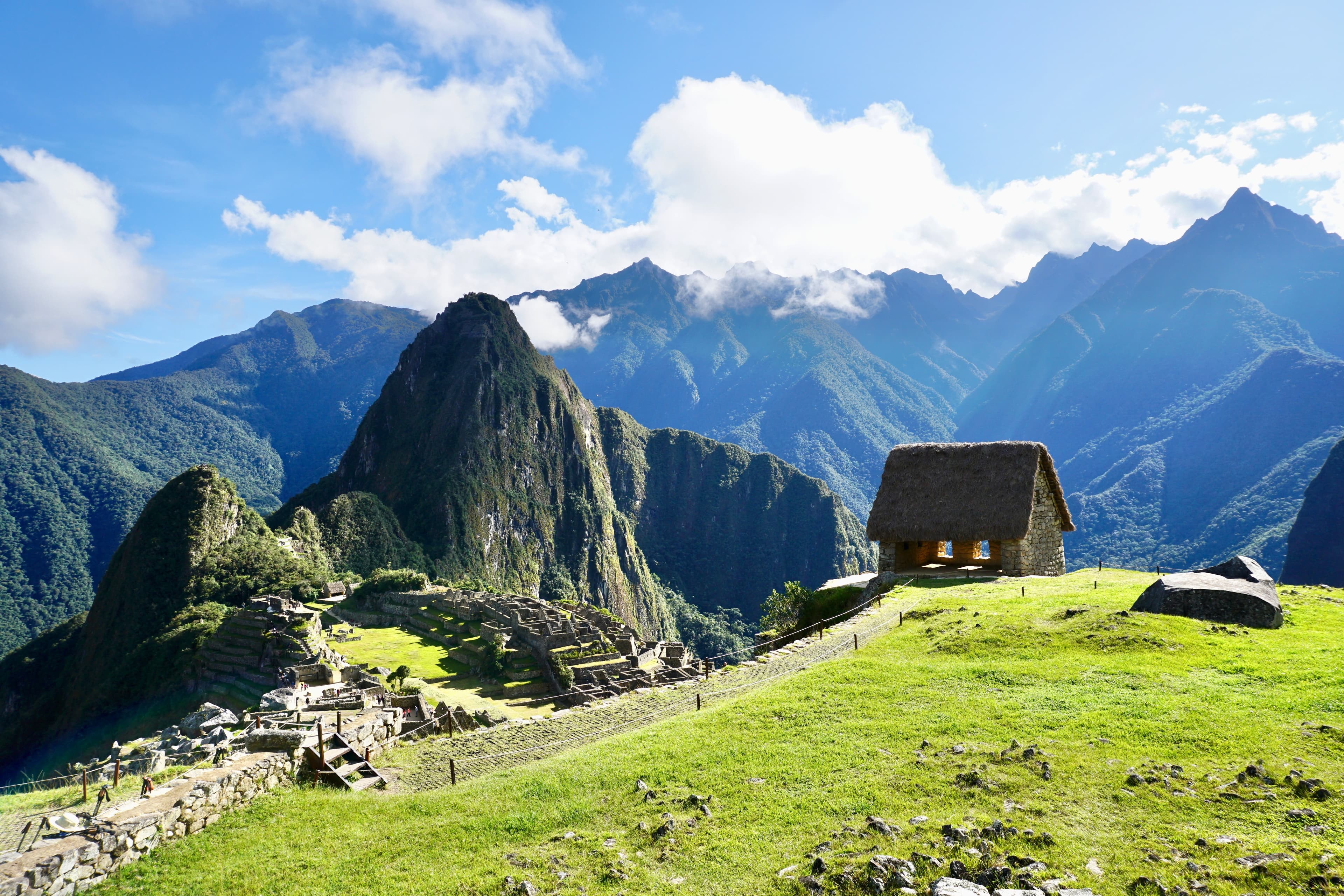
Here's the tip: wait it out. We held our position at the lookout for another hour and a half, and as the day warmed the clouds burned off. What emerged was the view everyone comes for: the full citadel, the terraces, and the surrounding temples with the green peaks rising behind them. It was worth every cold, blind minute of the wait.
What Machu Picchu actually is
Most people photograph Machu Picchu without knowing much about it, so here's what makes it extraordinary.
It was built around 1450 during the reign of the emperor Pachacuti, at the height of Inca expansion, most likely as a royal estate and sacred retreat. It sits at 2,430m (7,970ft), lower than Cusco, on a narrow ridge between two peaks, Machu Picchu and Huayna Picchu.
The construction is the part that stops engineers cold. The Inca built roughly 200 structures here without mortar, without the wheel, and without iron tools. The granite blocks are cut and fitted so precisely that in many places you cannot slide a knife blade between them. The site sits on two fault lines, and the stonework is engineered so that during earthquakes the stones actually shift and resettle back into place rather than collapsing.
It was abandoned about a century after it was built, around the time of the Spanish conquest. And here is the detail that saved it: the Spanish never found it. Because it was never conquered, it was never destroyed. It stayed wrapped in cloud forest, known to local farmers but unknown to the outside world, until the American historian Hiram Bingham brought it to global attention in 1911. It became a UNESCO World Heritage Site in 1983, and in 2007 it was named one of the New Seven Wonders of the World. Today it is the most visited site in South America.
If you don't want to trek
Machu Picchu is not only for hikers. If a four-day trek isn't your plan, you can still reach it comfortably. Fly into Cusco, then choose one of these:
- Train straight through. Take the train from Cusco to Aguas Calientes, then the shuttle bus from Aguas Calientes up to the Machu Picchu entrance.
- Bus, then train. Take a bus from Cusco to Ollantaytambo in the Sacred Valley, catch the train from Ollantaytambo to Aguas Calientes, then the bus up to the entrance. This route lets you break up the journey and see more of the Sacred Valley along the way.
Either option gets you to the same citadel. But if you have the days and the legs for it, the Salkantay Trek gives you something the train never will: glaciers, a turquoise lake, the Milky Way from an igloo, coffee farms, jungle, and a summit at 15,190ft, all before you ever lay eyes on Machu Picchu.
Need somewhere to recover after the trek? Read next: my guide to Mancora, Peru's laid-back surf town on the north coast.
These are affiliate links — booking through them supports Viator Modus at no extra cost to you. Same room, same price, it just helps keep the guides coming.
Found this useful?
If this guide helped plan your trip to Salkantay Trek, you can help fund the next one.
Buy me a coffee →