Southeast Asia
Jakarta is Indonesia's sprawling capital, a chaotic, humid megacity of more than 30 million people across its greater metropolitan area. It's a city most travelers skip on their way to Bali, but spend a few days here and you find a layered, fast-changing place where colonial Dutch architecture, glassy skyscrapers, traditional kampungs, and some of Southeast Asia's best street food coexist in dense, surprising ways.
Things to Do
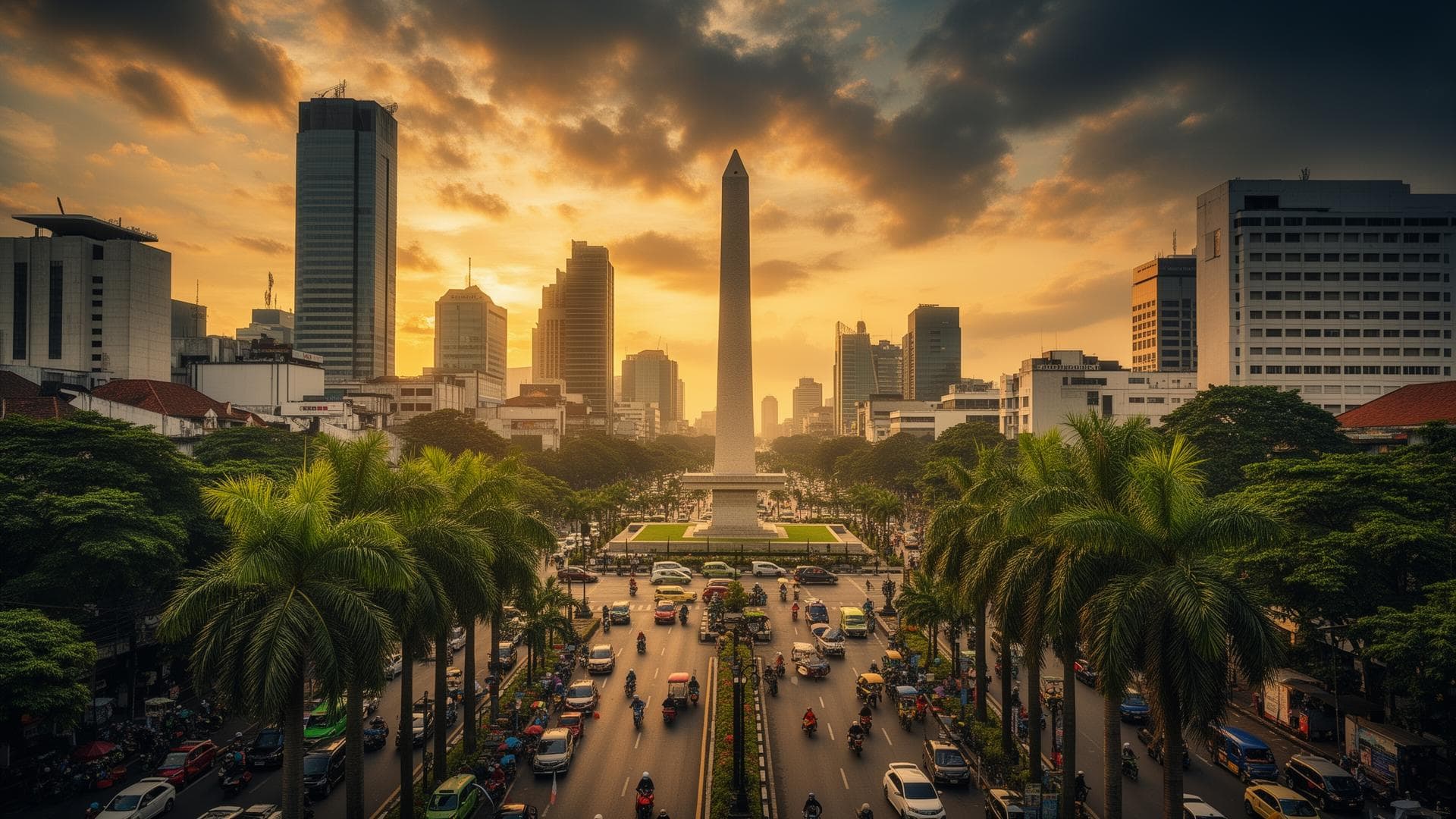
Wander the cobblestone square of Kota Tua (Old Town) and visit the Jakarta History Museum housed in the former Dutch city hall. Explore the National Monument (Monas) and the surrounding Merdeka Square, then step into the vast Istiqlal Mosque, the largest in Southeast Asia, directly across from the neo-Gothic Jakarta Cathedral. Eat your way through the food courts of Pasar Santa or the street stalls of Glodok (Chinatown). For a sharp contrast, spend an evening in the SCBD or Senopati districts among the rooftop bars and high-end restaurants.
Best Time to Visit
May through September is the dry season and by far the most comfortable time to visit. June to August are the driest months but also the busiest. The wet season (November through March) brings heavy afternoon downpours and frequent flooding in low-lying parts of the city. Traffic is brutal year-round but noticeably worse in the rainy season.
Where to Stay
Central Jakarta neighborhoods like Menteng and Thamrin put you near most major sights and have the best transit access. Kemang and Senopati are the lifestyle districts with boutique hotels, cafés, and nightlife. For a more local experience, look at homestays in Kebayoran Baru. Avoid staying near the airport, it's a long drive from anywhere worth visiting.
Budget: Wonderloft Hostel, well-run hostel in Kota Tua, walkable to Fatahillah Square and the old town museums.
Mid-range: Artotel Thamrin Jakarta, art-themed mid-range on Jalan Sunda, central for both Menteng and the Thamrin business strip.
Luxury: Mandarin Oriental Jakarta, long-standing five-star on the Hotel Indonesia roundabout, with one of the best spas in the city.
These are affiliate links — booking through them supports Viator Modus at no extra cost to you. Same room, same price, it just helps keep the guides coming.
Getting Around
Jakarta traffic is legendarily bad, so plan around it. The MRT (north–south) and the elevated LRT are the fastest ways to cover ground when their routes match yours. For everything else, Gojek and Grab (motorbike or car) are essential, drivers know the shortcuts through gangs (alleys) that taxis won't take. The TransJakarta BRT is cheap and surprisingly extensive but slow.
How big is Jakarta, really?
I flew in for a weekend from Bali, where I'd been living for a couple of months, and the scale reset my sense of what a city can be. You feel it on the descent — the built-up sprawl just keeps going, past every horizon, with no obvious edge. Greater Jakarta (Jabodetabek) holds more than 30 million people, which puts it among the largest metropolitan areas on the planet, and from the air you believe every number of it. I took a Gojek from the airport to my hotel, the Erian Hotel in Menteng, which is the right instinct here: a motorbike app is often the only thing that reliably beats the traffic. Soekarno-Hatta airport sits well west of the center, so the ride in is your first real dose of the sprawl before you've even dropped your bags.
The Dutch quarter and Chinatown
Central Jakarta is where the city's history is stacked most tightly. Around Merdeka Square you get the national set pieces — the square is built around Monas, the 132-meter independence obelisk Sukarno began in 1961, capped with a gold-plated flame. A little to the north, Kota Tua is old Batavia — the walled capital the Dutch East India Company ran for two centuries, its cobbled Fatahillah Square ringed by colonial buildings. I had a Javanese coffee at Cafe Batavia, which occupies a heritage building from around 1805, the second-oldest on the square after the former city hall that's now the Jakarta History Museum across the way.
From there I walked into Glodok, one of the oldest Chinatowns in Southeast Asia. Its lanes are full of traditional Chinese medicine — shelves of dried roots and bark — and I watched cupping therapy done the old way, with buffalo horns rather than glass cups. That's not a gimmick: cupping's oldest name in Chinese is jiaofa, the "horn method," because for two thousand years the cups were literally hollowed animal horns. Seeing it still practiced with horn, in a Chinatown this old, is the kind of thing you only get by stopping in the city most travelers fly straight over.
Hidden Gems
The Glodok neighborhood (Jakarta's Chinatown) is one of the most authentic and underexplored parts of the city, old herbal medicine shops, century-old temples like Vihara Dharma Bhakti, and some of the best Chinese-Indonesian food anywhere. The rooftop of Skye Bar in the BCA Tower offers one of the most dramatic city panoramas at sunset. And the Setu Babakan Betawi Cultural Village on the southern outskirts preserves the food, music, and architecture of Jakarta's indigenous Betawi people, a side of the city most visitors never see.
Most travelers only pass through Jakarta on the way somewhere better known, so read next: my guide to Bali, the island most of them are racing to reach.